

NPS
NPS 80% Lump Sum Tax Trap: Why Only 60% Is Tax-Free (2027)
PFRDA lets non-government subscribers take 80% of NPS as lump sum at exit, but tax law exempts only 60%. What the extra 20% costs, slab by slab, plus the annuity
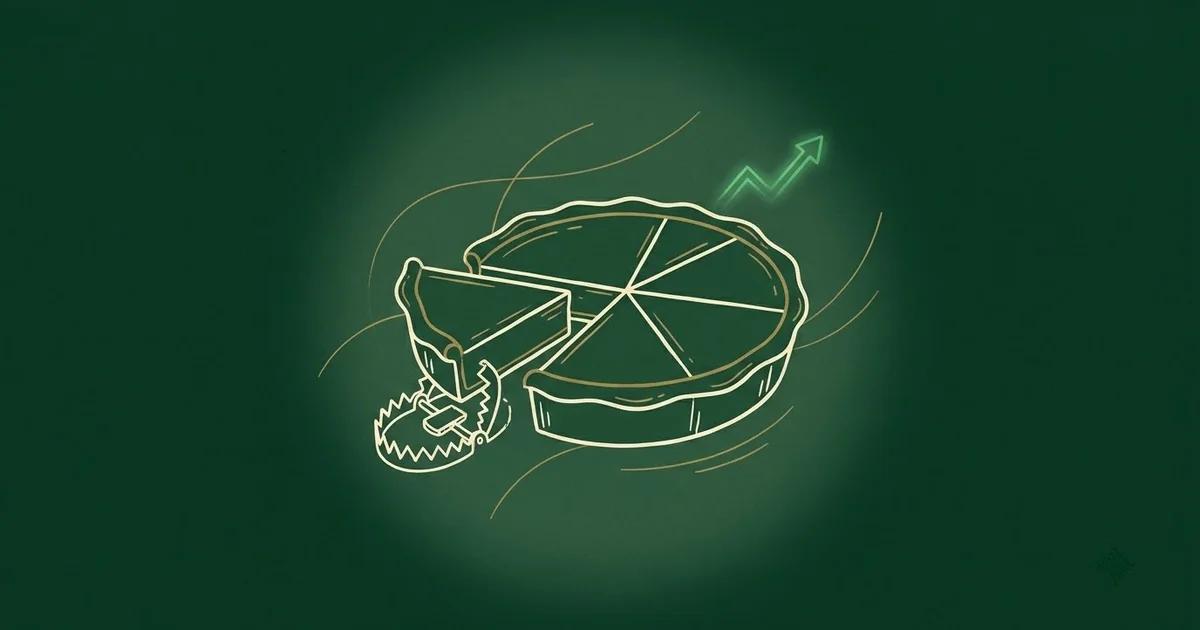
You put money into NPS for 20 years. Your corpus hits ₹15 lakh. Under the old rules, you had to park at least 40% (₹6 lakh) in an annuity and could only touch 60%.
In December 2025, PFRDA rewrote that for non-government subscribers. Here is what changed, what the new slabs mean, and the tax trap most articles skip.
Key takeaways
- Since December 2025, non-government NPS subscribers can take up to 80% of the corpus as lump sum at normal exit; at least 20% must buy an annuity.
- Only 60% of the lump sum is tax-free — the extra 20% is taxed at your income slab rate. Source: Income-tax Act, Schedule II, Sl. No. 6.
- Corpus of ₹8 lakh or less: 100% withdrawal allowed. ₹8–12 lakh: up to ₹6 lakh lump sum with the balance in SUR (minimum 6 years) or annuity. Above ₹12 lakh: 80/20 split.
- Government employees keep the 60/40 split, but did get the ₹8 lakh full-withdrawal limit and the ₹8–12 lakh SUR slab.
- SUR (Systematic Unit Redemption) redeems a fixed number of units at intervals — payouts float with NAV, minimum 6 years.
- If you have no other income in retirement, the new regime's ₹12 lakh rebate zone can absorb much of the taxable 20%.
The Big Change
| Subscriber type | Old rule | New rule (Dec 2025) |
|---|---|---|
| Government employees | 60% lump sum + 40% minimum annuity | Unchanged (still 60/40) |
| Non-government (All Citizen / Corporate) | 60% lump sum + 40% minimum annuity | 80% lump sum + 20% minimum annuity |
PFRDA nearly halved the forced-annuity share for non-government subscribers — more cash in your hand at retirement. Source: PFRDA (Exits and Withdrawals under the NPS) Amendment Regulations, December 2025; PIB press release, 19 December 2025.
But how much you can actually take depends on your total corpus.
The Three Corpus Slabs
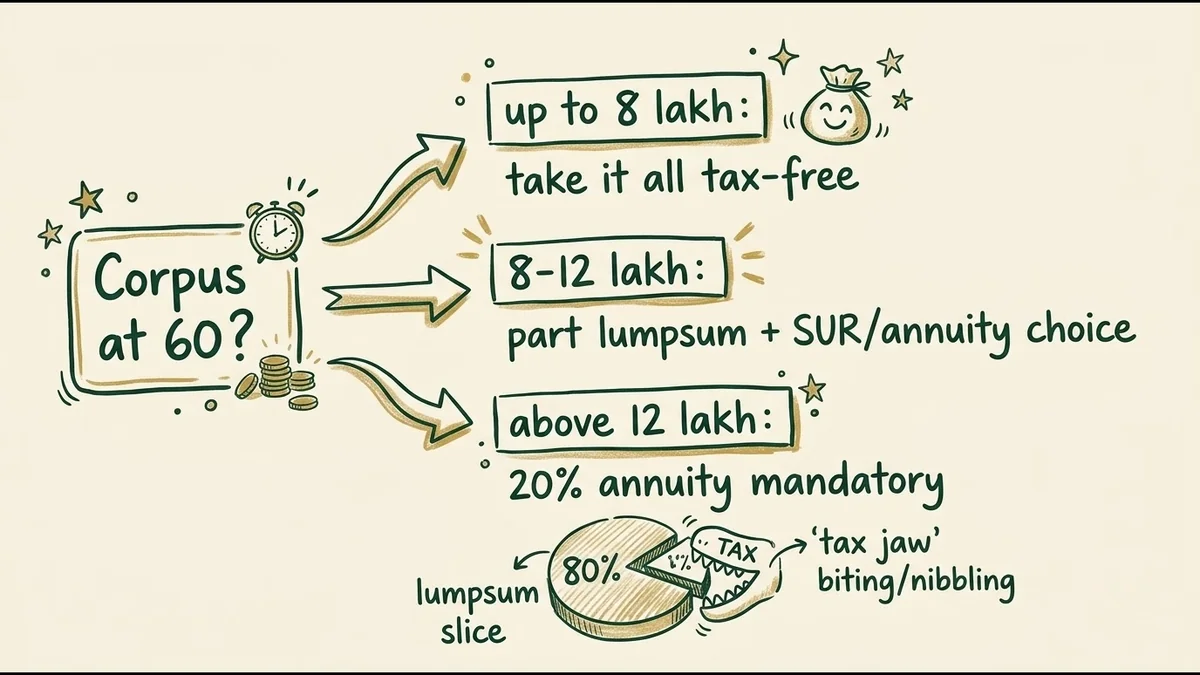
Slab 1: Corpus up to ₹8 Lakh
- Rule: 100% lump-sum withdrawal allowed
- Annuity required: zero
- Example: Rahul has ₹6.5 lakh in NPS at 60. He withdraws the whole amount — no forced annuity, no monthly pension.
But note the tax angle below: even in a full withdrawal, only 60% of the amount is exempt. The remaining 40% is taxed at your slab rate.
Slab 2: Corpus between ₹8 Lakh and ₹12 Lakh
| Option | Lump sum | Balance treatment |
|---|---|---|
| Option A | Up to ₹6 lakh | Rest into SUR — phased redemption over a minimum of 6 years |
| Option B | Up to ₹6 lakh | Buy an annuity with the rest |
| Option C | Up to 80% | Buy an annuity with at least 20% |
You get three options:
Example: Sunita has ₹10 lakh and picks Option A — ₹6 lakh now, the remaining ₹4 lakh paid out in phases through SUR for at least six years. Source: PFRDA All Citizen Exits & Withdrawals FAQ, updated March 2026.
Slab 3: Corpus above ₹12 Lakh
- Rule: up to 80% lump sum
- Annuity required: at least 20%
- Example: Ajay has ₹25 lakh. He takes ₹20 lakh as lump sum; the remaining ₹5 lakh buys an annuity that pays a monthly pension.
The Tax Trap
| Portion of lump sum | Tax treatment |
|---|---|
| First 60% | Tax-free |
| The 60–80% band | Added to income, taxed at your slab rate |
Here is the part that matters.
Only 60% of the lump sum from the NPS Trust is exempt from tax. That exemption — earlier Section 10(12A) of the Income-tax Act, 1961 — now sits in Schedule II, Sl. No. 6 of the Income-tax Act, 2025, which replaced the 1961 Act from 1 April 2026. The 60% cap was carried over unchanged. Source: Income Tax India, Schedule II.
PFRDA lets you withdraw up to 80%. The tax law has not followed. So:
Real Example: Priya (₹20 Lakh Corpus)
- Withdraws 80% = ₹16 lakh
- ₹12 lakh (60%) → tax-free
- ₹4 lakh (20%) → added to income, taxed at slab rate
- At the 30% bracket → about ₹1.20 lakh tax plus 4% cess (~₹1.25 lakh)
The annuity purchase itself is not taxed. But the pension the annuity pays is taxed as income every year — remember that when you compare SUR against an annuity.
Budget 2026 Did Not Fix This
Many expected Budget 2026 (February 2026) to align the exemption with the new 80% limit. It did not. As of November 2026 the mismatch persists. Until the tax law changes, plan for the extra 20% to be taxable at your slab rate.
Government Employees: 60/40 Stays, With Upgrades
The 60/40 split is unchanged for government subscribers. But they did get the threshold improvements: the full-withdrawal limit rose to ₹8 lakh (from ₹5 lakh), the new ₹8–12 lakh slab with a SUR option was added, and deferment now runs to age 85. Source: PIB press release on the exit-regulation amendments, December 2025.
What Is SUR?
SUR = Systematic Unit Redemption — a phased withdrawal inside NPS. Instead of taking everything at once or buying an annuity, a pre-determined number of units is redeemed at regular intervals.
- Minimum period: 6 years
- Payout: a fixed number of units — the rupee amount floats with NAV
- Contrast with SLW (Systematic Lump sum Withdrawal): SLW pays a fixed rupee amount at intervals; SUR redeems fixed units
Why Use SUR?
- In a rising market, the remaining corpus keeps growing while you withdraw.
- In a falling market, a fixed-unit redemption buys back flexibility without locking you into today's annuity rates (typically around 6–7%, varying by provider and age).
What To Do Next
1. Check your subscriber type. Non-government? The 80/20 rules apply. Government? 60/40 stays.
1. Estimate your corpus at 60. The slab you land in decides your options.
1. Do not assume 80% is tax-free. Only 60% is exempt; plan for tax on the rest.
1. Look at SUR if your corpus is ₹8–12 lakh — flexibility without locking into a low annuity yield.
1. Consider deferment. You can now stay invested (and defer the annuity purchase) up to age 85. During deferment, no new contributions are allowed — the existing corpus simply stays invested. Source: PFRDA exit regulations.
What the 60–80% Band Costs You, Slab by Slab
4 of 4 rows
| Your marginal slab | Tax on ₹4 lakh, plus 4% cess |
|---|---|
| 0% (inside the new-regime ₹12 lakh rebate zone) | Nil |
| 10% | ₹41,600 |
| 20% | ₹83,200 |
| 30% | ₹1,24,800 |
illustration: ₹20 lakh corpus, 80% withdrawal (₹16 lakh lump sum), taxable slice ₹4 lakh. What that slice costs depends on your marginal slab in the year of withdrawal:
These are illustrative figures on one assumption — that the whole ₹4 lakh lands in one slab. In reality it stacks on top of your other income, so part of it can fall in a lower bracket. The point stands: ignoring the 60% line can cost anything from nothing to about ₹1.25 lakh at this corpus size.
Two practical levers follow from the table:
1. Time the withdrawal against your income. If you retire mid-year with salary still flowing, taking the 80% lump sum in the same financial year stacks the taxable 20% on top of salary income. Pushing the withdrawal into a low-income year can cut the bill sharply.
1. Spread the exit with SLW. Instalments stretch across financial years, and each year's taxable slice is assessed separately. Splitting a ₹4 lakh taxable slice across two years can drop part of it out of the 30% bracket.
The TDS Question at Exit
Do not assume the full lump sum lands in your account. After the payout credits, open your Form 26AS / AIS — if tax was deducted at source on the taxable portion before credit, it shows there and counts against your final liability when you file. Whatever the withholding turns out to be, the slab-rate arithmetic above is what you actually owe; reconciling the two is a routine ITR exercise. If the numbers do not line up, that mismatch goes to your CA, not to the CRA.
The Annuity Side of the Ledger
The tax story does not end at withdrawal. The annuity purchase itself is not taxed, but every pension payment the annuity makes is added to your income for the rest of your life. That converts the compulsory 20% into a small recurring tax bill — usually modest at pension-level incomes, but it belongs in the arithmetic before you pick an annuity provider, because the rate you lock in is fixed while the tax treatment follows your income each year.
The mistake to avoid: counting the annuity portion as tax-free
A quieter version of this trap runs the other way. Some subscribers assume that because the annuity purchase is compulsory, the money going into the annuity must be tax-free. It is not taxed at the moment of purchase, which feels similar — but the pension it pays is taxable income every year, for life. The 60% exemption applies only to the lump sum paid by the NPS Trust, never to the annuity stream that follows. Source: Income-tax Act, Schedule II, Sl. No. 6.
For the ₹8–12 lakh slab, SUR raises a similar open question: the regulations spell out the redemption mechanics, but how a phased redemption interacts with the 60% exemption in your specific case is worth getting from your CA in writing before you choose SUR over an annuity.
Bottom Line
The December 2025 PFRDA changes are genuinely good news: you can now keep 80% of your money instead of being forced into a 40% annuity. But the tax law has not caught up — only 60% is exempt. Don't let the new flexibility surprise you with a tax bill. If a future budget aligns the two, NPS gets even better; until then, plan your exit around the 60% line.
---
This is for educational purposes only, not investment or tax advice. Consult a qualified financial advisor for personalized advice. Tax rules are subject to change in future budgets.
Frequently asked questions
How much of the NPS lump sum is tax-free?
60% of the lump sum paid by the NPS Trust is exempt; anything beyond 60% — for example the band from 60% to 80% under the new PFRDA rules — is added to your income and taxed at your slab rate. Source: Schedule II, Sl. No. 6, Income-tax Act, 2025.
Can I withdraw 100% of my NPS corpus?
Only if your total corpus is ₹8 lakh or less at exit — then a full lump-sum withdrawal is allowed with no annuity. Above that, at least 20% of the corpus must be annuitised for non-government subscribers.
What is SUR in NPS?
Systematic Unit Redemption is a phased exit: instead of one lump sum or an annuity, a pre-determined number of units is redeemed at regular intervals, with payouts that float with NAV. For the ₹8–12 lakh slab it runs for a minimum of 6 years. Source: PFRDA exit regulations, December 2025.
Did Budget 2026 make the extra 20% tax-free?
No. The 60% exemption cap was not extended to 80% in Budget 2026, so withdrawals beyond 60% remain taxable at slab rates. Plan for the tax unless the law changes.
About the author
Om Patel is an investor, blogger and entrepreneur. Every guide is educational, not personalised advice; rates and rules are cited to official sources and reviewed with a visible date.
Educational content, not personalised advice. Rates change — verify on the bank's site before opening an account. How we make money