

Tax & Compliance
Old vs New Tax Regime FY 2027-28: Which is Better?
Old vs new tax regime for FY 2027-28 compared: slab tables, the Rs 12 lakh 87A rebate, standard deduction, and when the old regime still wins.
In this guide
- The Core Difference in One Paragraph
- Tax Slab Comparison — FY 2026-27 (AY 2027-28)
- Tax Calculation at 5 Income Levels
- Who Wins at Each Income Level?
- The 87A Rebate — Why Rs 12.75 Lakh is Effectively Zero Tax
- Deductions Comparison — What You Lose in the New Regime
- One More Thing — This Year is a Milestone
- Your Decision Framework
- Action Steps
ITR season is here. And if you're a salaried employee, there's one question that's probably bothering you: old regime ya new regime?
This is the most confusing tax decision most Indians make every year. And with the Income Tax Act 2025 now in force from FY 2026-27 (slabs unchanged), it is worth re-running the comparison.
Let me break it down so you can decide in 5 minutes.
The new regime is the default and works better for most salaried people — especially if your income is under Rs 12.75 lakh. But if you have significant deductions, don't blindly pick new. Spend 10 minutes comparing both. That 10 minutes could save you over a lakh in taxes.
---
Disclaimer: This article is for educational purposes only. Tax laws are subject to change. Please consult a qualified Chartered Accountant for personalized tax advice.
Key takeaways
- New regime slabs are unchanged for FY 2026-27: nil up to Rs 4 lakh, then 5% to 30% across seven bands — Budget 2026 made no changes.
- Under the new regime, Section 87A wipes out the full Rs 60,000 slab tax if your total income is up to Rs 12 lakh.
- Salaried employees pay zero tax up to Rs 12.75 lakh gross salary in the new regime — Rs 12 lakh taxable after the Rs 75,000 standard deduction.
- Only two deductions survive in the new regime: the Rs 75,000 standard deduction and employer NPS under 80CCD(2).
- The old regime only beats the new one when your combined deductions (80C, 80D, HRA, home loan interest) are roughly Rs 4 lakh or more.
- Just above Rs 12 lakh income, marginal relief caps your tax at the amount by which income exceeds Rs 12 lakh.
- Salaried taxpayers can switch regimes every year; business taxpayers wanting the old regime must file Form 10-IEA before the deadline.
The Core Difference in One Paragraph
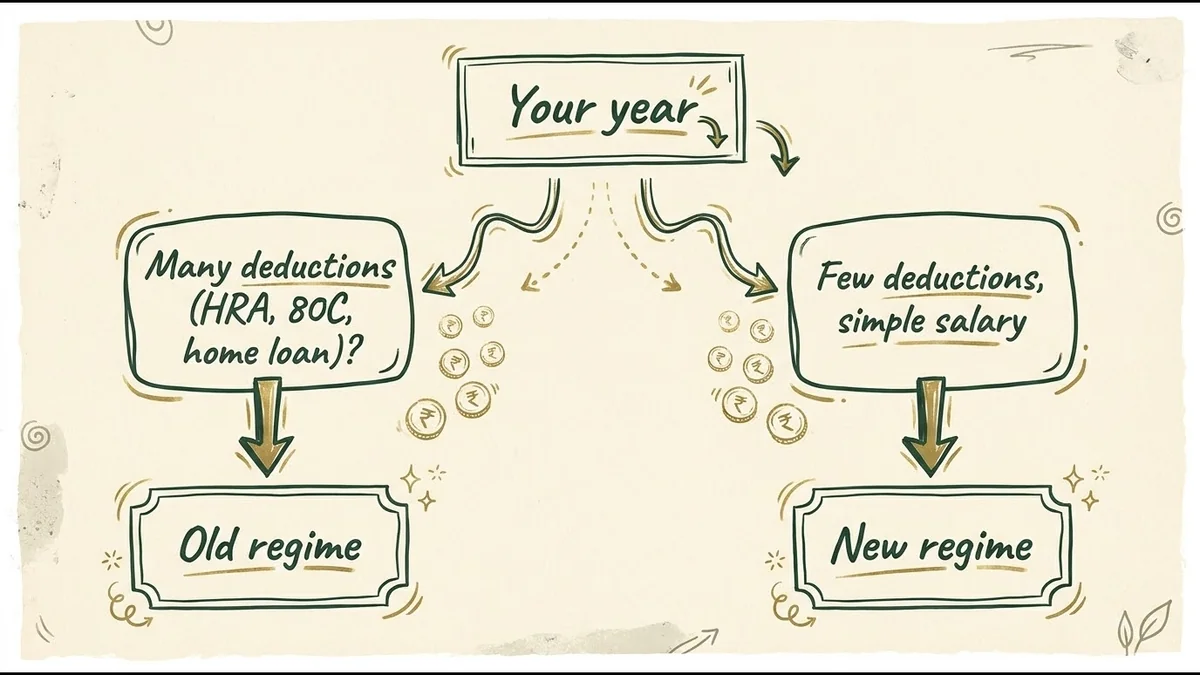
The new regime gives you lower tax rates but takes away almost all deductions and exemptions. The old regime has higher rates but lets you claim deductions like 80C, HRA, 80D, home loan interest, and more. Simple enough? Pick new if you don't have many deductions. Pick old if you do.
Tax Slab Comparison — FY 2026-27 (AY 2027-28)
Budget 2026 left both regimes untouched, so the slabs below are what you'll actually pay on income earned between April 1, 2026 and March 31, 2027. Source: PIB, Union Budget 2026-27 summary; PRS Legislative Research Budget analysis.
New Tax Regime (Default):
7 of 7 rows
| Income Slab | Tax Rate |
|---|---|
| Up to Rs 4,00,000 | Nil |
| Rs 4,00,001 – Rs 8,00,000 | 5% |
| Rs 8,00,001 – Rs 12,00,000 | 10% |
| Rs 12,00,001 – Rs 16,00,000 | 15% |
| Rs 16,00,001 – Rs 20,00,000 | 20% |
| Rs 20,00,001 – Rs 24,00,000 | 25% |
| Above Rs 24,00,000 | 30% |
Old Tax Regime (Below 60 years):
4 of 4 rows
| Income Slab | Tax Rate |
|---|---|
| Up to Rs 2,50,000 | Nil |
| Rs 2,50,001 – Rs 5,00,000 | 5% |
| Rs 5,00,001 – Rs 10,00,000 | 20% |
| Above Rs 10,00,000 | 30% |
Note the gap in the entry bands: the new regime's nil tax extends to Rs 4 lakh, the old regime's stops at Rs 2.5 lakh. That difference alone decides the comparison for most people with modest deductions.
Tax Calculation at 5 Income Levels
Let's see actual numbers. I'm assuming a salaried person under 60, and for the old regime, claiming Rs 2 lakh in deductions (Rs 1.5L under 80C + Rs 50,000 standard deduction).
Don't stress about memorizing the slabs. Just find your income in the table below and see what you'd actually pay.
New Regime:
5 of 5 rows
| Gross Income | Std Ded | Taxable Income | Total Tax (After Rebate + Cess) |
|---|---|---|---|
| Rs 6,00,000 | Rs 75,000 | Rs 5,25,000 | Rs 0 |
| Rs 9,00,000 | Rs 75,000 | Rs 8,25,000 | Rs 0 |
| Rs 12,00,000 | Rs 75,000 | Rs 11,25,000 | Rs 0 |
| Rs 15,00,000 | Rs 75,000 | Rs 14,25,000 | Rs 97,500 |
| Rs 20,00,000 | Rs 75,000 | Rs 19,25,000 | Rs 1,92,400 |
Old Regime (with Rs 2L deductions):
5 of 5 rows
| Gross Income | Deductions | Taxable Income | Total Tax (After Rebate + Cess) |
|---|---|---|---|
| Rs 6,00,000 | Rs 2,00,000 | Rs 4,00,000 | Rs 0 |
| Rs 9,00,000 | Rs 2,00,000 | Rs 7,00,000 | Rs 54,600 |
| Rs 12,00,000 | Rs 2,00,000 | Rs 10,00,000 | Rs 1,17,000 |
| Rs 15,00,000 | Rs 2,00,000 | Rs 13,00,000 | Rs 2,10,600 |
| Rs 20,00,000 | Rs 2,00,000 | Rs 18,00,000 | Rs 3,66,600 |
Who Wins at Each Income Level?
But here's the catch — if you have big deductions (HRA in a metro city, home loan interest, 80D for parents, education loan interest), the old regime can still be better at higher incomes. As a working rule, you need roughly Rs 4 lakh or more in combined deductions before the old regime starts winning, and the exact break-even depends on your salary level. Source: cross-checked against CA Club India's FY 2026-27 regime comparison.
The 87A Rebate — Why Rs 12.75 Lakh is Effectively Zero Tax
Under the new regime, Section 87A gives you a full rebate of up to Rs 60,000 if your total income is up to Rs 12 lakh — which exactly cancels the Rs 60,000 slab tax at that level. For salaried employees with the Rs 75,000 standard deduction, this means:
If your gross salary is up to Rs 12.75 lakh, your tax is ZERO.
Three limits to know: the rebate is only for resident individuals (NRIs can't claim it), it applies only against slab-rate tax (not capital gains or other special-rate income), and just above Rs 12 lakh a marginal relief rule caps your tax at the amount by which your income exceeds Rs 12 lakh — so crossing the line by a few thousand rupees doesn't suddenly cost you Rs 60,000.
Under the old regime, the rebate is unchanged at Rs 12,500 for total income up to Rs 5 lakh (effectively Rs 5.5 lakh taxable income for salaried with the Rs 50,000 standard deduction). Source: Income Tax Act / Section 87A (Section 156 under the Income-tax Act, 2025).
This is probably the single biggest tax benefit for the middle class right now. No deductions needed. No investments required. Just file your return and pay nothing.
Deductions Comparison — What You Lose in the New Regime
8 of 8 rows
| Deduction / Exemption | Old Regime | New Regime |
|---|---|---|
| Section 80C (PPF, ELSS, LIC, NSC) | Up to Rs 1,50,000 | Not available |
| Section 80D (Health Insurance) | Up to Rs 25K + Rs 50K for parents | Not available |
| HRA Exemption | Available | Not available |
| LTA Exemption | Available | Not available |
| Home Loan Interest (Section 24b) | Up to Rs 2,00,000 | Not available |
| Education Loan Interest (80E) | Unlimited | Not available |
| Standard Deduction | Rs 50,000 | Rs 75,000 |
| NPS Employer (80CCD(2)) | Available | Available, up to 14% of salary |
That's the whole deal: only the standard deduction and employer NPS contributions survive in the new regime. Everything else — 80C, 80D, HRA, LTA, home loan interest — is gone.
One More Thing — This Year is a Milestone
AY 2026-27 was the last assessment year under the Income Tax Act, 1961. From April 1, 2026, the Income-tax Act, 2025 applies. The slab rates haven't changed for FY 2026-27, but the framework has shifted.
What this means for you: the slab math is unchanged, but from this year the section numbers look different — the 87A rebate, for example, sits in Section 156 of the new Act, and TDS has moved to Sections 392-394. Your return forms and portal flows will follow the new Act's numbering going forward.
Your Decision Framework
Ask yourself these questions:
1. Do you claim HRA? If yes, old regime might work.
1. Do you have a home loan? If yes, old regime could be better.
1. Do you invest in PPF, ELSS, or LIC under 80C? If yes and totaling over Rs 1.5L, run the comparison.
1. Do you pay health insurance premiums? If yes for yourself and parents, it adds up.
1. Is your gross income below Rs 12.75 lakh? If yes, new regime = zero tax. No brainer.
Action Steps
- Log in to the income tax portal (incometax.gov.in)
- Use the tax calculator to compare both regimes with YOUR actual numbers
- If you're a business taxpayer and want the old regime, file Form 10-IEA before the ITR deadline
- For salaried employees, you can switch every year — no commitment needed
- Consult a CA if you have rental income, capital gains, or multiple income sources
Frequently asked questions
Which tax regime is better for FY 2026-27?
For most salaried people the new regime wins, because incomes up to Rs 12.75 lakh (after the Rs 75,000 standard deduction) carry zero tax. The old regime only wins if your total deductions — 80C, 80D, HRA, home loan interest — add up to roughly Rs 4 lakh or more.
What is the 87A rebate in the new regime for FY 2026-27?
Up to Rs 60,000, for resident individuals with total income up to Rs 12 lakh. It cancels the entire slab tax at that income level. It does not apply against special-rate income such as long-term capital gains.
Did Budget 2026 change the income tax slabs?
No. Budget 2026 left the FY 2026-27 slab structure untouched under both regimes, along with the Rs 12 lakh rebate ceiling and the Rs 75,000 standard deduction. Source: PIB, Union Budget 2026-27 summary.
How much salary is tax-free under the new regime?
Gross salary up to Rs 12.75 lakh is effectively tax-free: the Rs 75,000 standard deduction brings taxable income to Rs 12 lakh, where the Rs 60,000 Section 87A rebate wipes out all slab tax.
Can I switch between old and new regime every year?
Yes, salaried taxpayers choose a regime afresh each year while filing. Business and professional taxpayers who want the old regime must file Form 10-IEA before their ITR due date.
About the author
Om Patel is an investor, blogger and entrepreneur. Every guide is educational, not personalised advice; rates and rules are cited to official sources and reviewed with a visible date.
Educational content, not personalised advice. Rates change — verify on the bank's site before opening an account. How we make money