

Personal Finance
Emergency Fund Bucket Strategy for India (2027)
The bucket approach to emergency funds: month one in a sweep FD, months two to six in liquid funds, long-tail reserves in short-term debt — with refill rules.

In this guide
- What Is an Emergency Fund?
- Why Savings Accounts Are Bleeding You Money in 2027
- The Simple 2-Bucket Setup
- The Advanced 3-Bucket Setup
- Bucket Sizes by Salary
- Post-Tax Returns Comparison
- The Real-World Return Math: ₹6 Lakh Emergency Fund
- Build Plan: From Zero to Full Fund
- Risk Flags
- Common Myths
- Your Action Step Today
If you have ₹6 lakh sitting in a regular savings account earning 2.5% interest, you're making ₹15,000 a year. After tax at 30% (and under the new regime, Section 80TTA doesn't apply), you take home ₹10,500. Meanwhile, that same ₹6 lakh in a properly structured emergency fund earns ₹21,924 post-tax. That's ₹11,424 more per year. Same money, same safety, just split across better accounts. Here's how to set it up. (Or just skip to the Action Steps at the bottom.)
Your emergency fund should be safe, accessible, and earn a reasonable return — not sit in a savings account earning 2.5% while inflation eats 6-7%. A 2-bucket strategy (savings + liquid fund) takes 30 minutes to set up and earns 2-3x more than a regular savings account. Start today. Sources: RBI DICGC deposit insurance, SEBI liquid fund regulations, RBI Monetary Policy April 2026 (repo rate 5.25%), Income Tax Dept, CreditSmart.in, HonestMoney.in, TheSalaryInvestor, ProfitNifty.in.
---
This is educational content, not financial advice. Liquid mutual funds are not guaranteed — though historically stable, they carry minimal market risk. Consult a qualified financial advisor for your specific situation.
Key takeaways
- Bucket 1: one month of expenses in a sweep-in FD — instant, card-accessible liquidity.
- Bucket 2: months two to six in a liquid fund — T+1 redemption, better yield than savings.
- Bucket 3 (optional): 6-12 months for volatile incomes in short-term debt funds or rolled FDs.
- Never put an emergency bucket in equity — the crash-and-job-loss correlation is exactly the risk.
- Refill rule: pause all investing until the withdrawn bucket is whole again.
What Is an Emergency Fund?
An emergency fund is 3-6 months of essential expenses parked in safe, instantly accessible instruments. Essential expenses, not your income. If your salary is ₹1 lakh but you spend ₹50,000 on rent, food, EMI, insurance, and transport, your target is ₹1.5-3 lakh, not ₹6 lakh.
How Much Do YOU Need?
4 of 4 rows
| Your Situation | Target | Why |
|---|---|---|
| Single, stable job, no dependents | 3 months | Quick re-employment likely |
| Married, single income, no kids | 6 months | Partner depends on this income |
| Married with kids + home loan EMI | 6-9 months | EMI bounce = penalty + credit score hit |
| Freelancer / self-employed | 12 months | Income gaps stretch for months |
Source: RBI financial literacy guidelines; SEBI investor education
Why Savings Accounts Are Bleeding You Money in 2027
Three problems with keeping your emergency fund in a regular savings account:
1. Returns Are Pathetic
| Bank | Savings Rate |
|---|---|
| SBI | 2.50% |
| HDFC Bank | 2.50% |
| ICICI Bank | 2.70-3.00% |
2. Section 80TTA Is Gone Under New Regime
Under the new tax regime (which 90%+ of salaried people use), the ₹10,000 deduction on savings interest (Section 80TTA) is not available. All savings interest is fully taxable at your slab rate. At 30% tax slab: 2.5% × (1 – 0.30) = 1.75% post-tax return. Your emergency fund is losing money to inflation every single year.
3. Better Options Exist With Same Safety
Liquid mutual funds earn 6.3-6.5%. Small finance banks pay 6.5-8.5% on savings accounts. Sweep-in FDs give 6.25-7% with instant access to a portion. All with DICGC insurance up to ₹5 lakh per bank. Source: SBI/HDFC rates via BankBazaar May 2026; SFB rates via CalcPhi May 2026; Income Tax Act Section 80TTA
The Simple 2-Bucket Setup
| Bucket | % of Fund | Where | Access Time | Purpose |
|---|---|---|---|---|
| Bucket 1: Instant | 10-25% | High-yield savings account | Instant (UPI/ATM) | True day-0 emergencies |
| Bucket 2: Core | 75-90% | Liquid mutual fund | T+1 (next business day) | Bulk of fund, earns 6.3-6.5% |
This is what most people should use:
Example: For a ₹6 lakh emergency fund:
- ₹50,000 in savings (instant access)
- ₹5,50,000 in liquid fund (earns 6.3%)
Liquid fund instant redemption: You can get up to ₹50,000 instantly per scheme per day (SEBI rule). For bigger emergencies, rest arrives next business day. Source: HonestMoney.in; CreditSmart.in; TheSalaryInvestor
The Advanced 3-Bucket Setup
| Layer | % of Fund | Instrument | Access Time | Returns |
|---|---|---|---|---|
| Layer 1: Instant | 30% | Savings account (SFB for higher rate) | Instant | 2.5-8.5% |
| Layer 2: Next-Day | 30% | Liquid mutual fund | T+1 (instant up to ₹50K/day) | 6.3-6.5% |
| Layer 3: 3-7 Day | 40% | Sweep-in FD / FD ladder / Arbitrage fund | 1-7 days | 6.5-7.0% |
!undefined — explainer sketch, The Wealth Blog
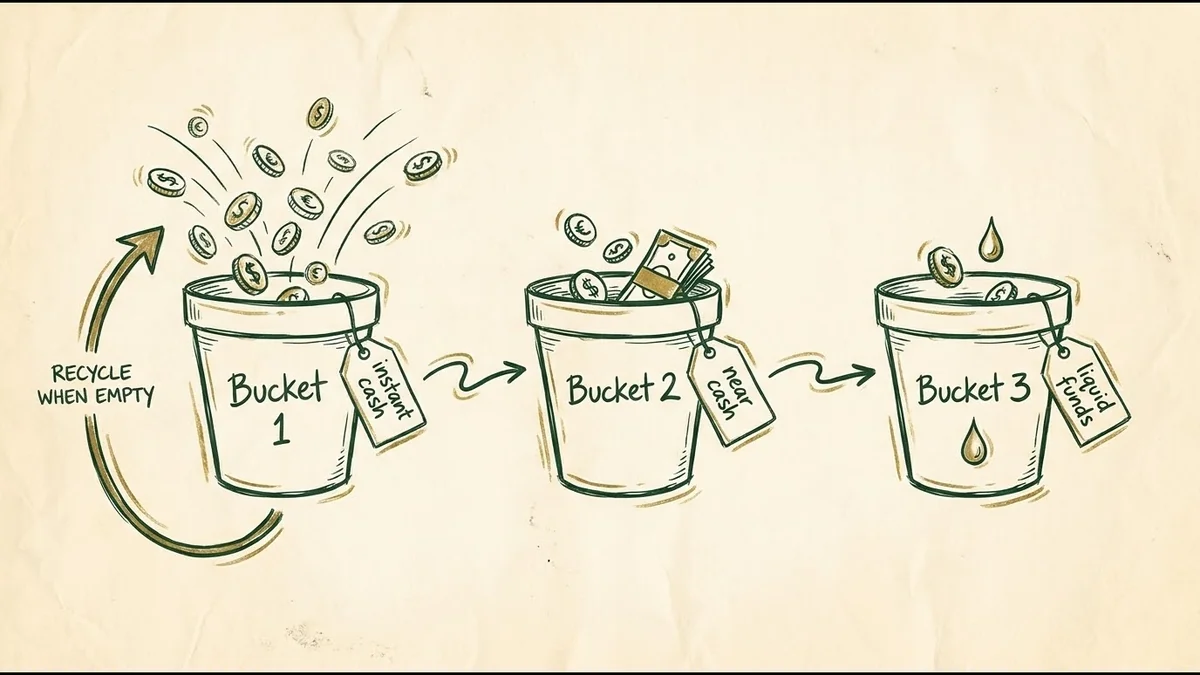
For those earning ₹1 lakh+ monthly, this maximises returns:
The FD ladder trick: Create 4 FDs of ₹90K each maturing quarterly. One always matures within 90 days — you never pay premature withdrawal penalty. Net returns: ~6.5-7%. Arbitrage funds for Layer 3: Returns ~6.5%. Taxed as equity (12.5% LTCG above ₹1.25L after 12 months). At 30% slab, post-tax is 5.69% — vs liquid fund's 4.45%. Great for money you won't need for 12+ months. Source: SEBI liquid fund regulations; HonestMoney.in arbitrage analysis; ProfitNifty.in
Bucket Sizes by Salary
4 of 4 rows
| Monthly Take-home | Essential Expenses | 6-Month Target | Bucket 1 (Instant) | Bucket 2 (Liquid Fund) | Bucket 3 (FD/Sweep) |
|---|---|---|---|---|---|
| ₹30,000 | ₹18-22K | ₹1.1-1.3L | ₹25K | ₹70K | ₹20K |
| ₹50,000 | ₹30-35K | ₹1.8-2.1L | ₹40K | ₹1.2L | ₹40K |
| ₹1,00,000 | ₹55-65K | ₹3.3-3.9L | ₹60K | ₹2.2L | ₹80K |
| ₹2,00,000 | ₹1.1-1.3L | ₹6.6-7.8L | ₹1L | ₹4.5L | ₹2L |
Source: CreditSmart.in emergency fund guide
Post-Tax Returns Comparison
5 of 5 rows
| Instrument | Pre-Tax Return | Post-Tax (5% slab) | Post-Tax (20% slab) | Post-Tax (30% slab) |
|---|---|---|---|---|
| SBI Savings (2.5%) | 2.50% | 2.38% | 2.00% | 1.75% |
| Small Finance Bank (7%) | 7.00% | 6.65% | 5.60% | 4.90% |
| Liquid Fund (6.35%) | 6.35% | 6.03% | 5.08% | 4.45% |
| Sweep-in FD (6.25%) | 6.25% | 5.94% | 5.00% | 4.38% |
| Arbitrage Fund (6.5%) | 6.50% | 6.50% | 6.50% | 5.69% |
Note: Under new regime, 80TTA doesn't apply — savings interest fully taxable. Key insight: At the 30% slab, arbitrage funds beat everything on post-tax returns — but you need 12+ months holding and occasional NAV dips make them unsuitable for Layer 1 or 2.
The Real-World Return Math: ₹6 Lakh Emergency Fund
Scenario A: All in SBI Savings
- Annual return: ₹15,000
- Post-tax (30% slab): ₹10,500
Scenario B: Proper Architecture
- ₹1.8L savings + ₹1.8L sweep FD (6.5%) + ₹2.4L liquid fund (6.3%)
- Returns: ₹4,500 + ₹11,700 + ₹15,120 = ₹31,320
- Post-tax (30% slab): ₹21,924
Extra: ₹11,424/year. Over 5 years that's ₹57,120 — just for moving money to better accounts.
Build Plan: From Zero to Full Fund
Month 1-6: Get your first month covered
Start putting aside ₹2,000-5,000 each month into a savings account. Your only goal right now: cover one month of essential expenses. Skip SIPs for now — you need this safety net before you invest anything.
Month 7-18: Three-month target
₹10,000-25,000/month split across buckets. Open a liquid fund account (easiest via Kuvera, Groww, or Coin). Set up SIP into liquid fund on salary date + 1. Run SIP and emergency fund top-up in parallel (60/40 split).
Month 18-30: Full fund
Continue until 6 months reached. At 3 months: shift to 80% SIP / 20% emergency top-up. At 6 months: 100% SIP. Why not wait for full emergency fund before starting SIPs? Building from zero before any SIP costs 1-2 years of compounding. The 60/40 parallel approach gets you both.
Risk Flags
1. Liquid fund exit load: Graded exit load for first 7 days only. After 7 days, zero. Hold minimum 7 days.
1. SEBI instant redemption cap: ₹50,000/day per scheme. For ₹2L emergency: ₹50K instant, ₹1.5L next business day.
1. DICGC ₹5L limit: For emergency fund above ₹5L, spread across 2-3 banks. ₹5L at SFB + ₹5L at major bank + rest in liquid fund.
1. SFB rate changes: Small finance bank rates can change. Don't assume 7%+ forever.
1. Inflation erosion: At 6-7% inflation, liquid fund returns of 6.3-6.5% barely maintain purchasing power. The goal isn't growth — it's safety + accessibility.
1. Don't oversize: Once you hit 9-12 months of expenses, excess earns near-zero real returns. Move surplus to long-term equity investments.
1. Retired persons: Need 12-18 months coverage due to higher medical risk. Keep in sweep-in FD + short-term debt funds.
Common Myths
7 of 7 rows
| Myth | Reality |
|---|---|
| "Keep it all in FD for higher returns" | FDs charge 0.5-1% penalty for premature withdrawal. Use sweep-in FD or liquid fund. |
| "Liquid funds are risky" | Top funds from large AMCs invest in T-bills and AAA paper. Worst-case drawdown ~-0.5% over few days. |
| "Emergency fund = 6 months of income" | Wrong. It's 3-6 months of essential expenses, not income. |
| "Small finance banks aren't safe" | False. Same DICGC ₹5L insurance as SBI. Same RBI regulation. |
| "80TTA protects my savings interest" | False under new regime. Fully taxable at slab rate. |
| "Equity is fine for emergency fund" | False. Job loss and market crash often happen together. Keep it safe. |
| "Keep everything in one instrument" | Wrong. Never put emergency fund in a single place. Diversify. |
Your Action Step Today
Frequently asked questions
What is the bucket strategy for emergency funds?
Splitting the fund by access speed: instant money in a sweep FD, near-instant in liquid funds, and longer reserves in short-term debt — each bucket matched to how fast you would need it.
How much goes in each emergency bucket?
One month of expenses in bucket 1, months two through six in bucket 2, and optionally months 7-12 in bucket 3 for single-income or freelance households.
Can emergency buckets earn better returns?
Safely, only slightly — liquid funds add 0.5-1% over savings rates. Chasing more yield puts the fund's purpose at risk; the job is availability, not growth.
About the author
Om Patel is an investor, blogger and entrepreneur. Every guide is educational, not personalised advice; rates and rules are cited to official sources and reviewed with a visible date.
Educational content, not personalised advice. Rates change — verify on the bank's site before opening an account. How we make money