Are You Losing Money in Your Bank Account?
Most people don’t realize this. The savings account you opened five years ago is probably paying you around 2.50% interest. A Small Finance Bank might pay close to 7%.
On Rs 5 lakh, that gap works out to roughly Rs 18,000 to 20,000 a year (assuming a blended SFB rate of around 6.4%). The actual difference between a 2.5% PSU account and a 7% SFB account would be about Rs 22,500. Both are insured by DICGC up to Rs 5 lakh per depositor per bank, whether you’re with a PSU bank like SBI or a Small Finance Bank. You get the same UPI, debit card, and net banking. You just earn more for the same convenience.
This guide covers the three types of accounts, the best bank accounts in 2026 with real numbers, the new RBI rules, and the one move worth making today.
What Actually Is a Bank Account?
Think of it as a locker for your money that you can also spend from. You put money in, the bank keeps it safe, and you take it out through an ATM, UPI, or net banking.
In India you’ll hear about three main types:
1. Savings account – your personal account that earns interest
2. Current account – for businesses, no interest, no RBI-imposed transaction limit
3. Zero-balance account – a savings account with no minimum balance rule
Let’s go through each, then look at the best options with real 2026 numbers.
The 3 Types of Bank Accounts, Explained Simply
1. Savings Account
This is what most Indians have. It earns interest (unlike a current account). You can open one at SBI, HDFC, ICICI, or a Small Finance Bank like AU or Equitas.
- Who it’s for: Salaried people, students, retirees, anyone who wants to save and earn a little interest.
- Interest: Ranges from about 2.50% (SBI) to 7.00% at the best Small Finance Bank slab (Equitas SFB on Rs 1–5 lakh), depending on the bank and your balance.
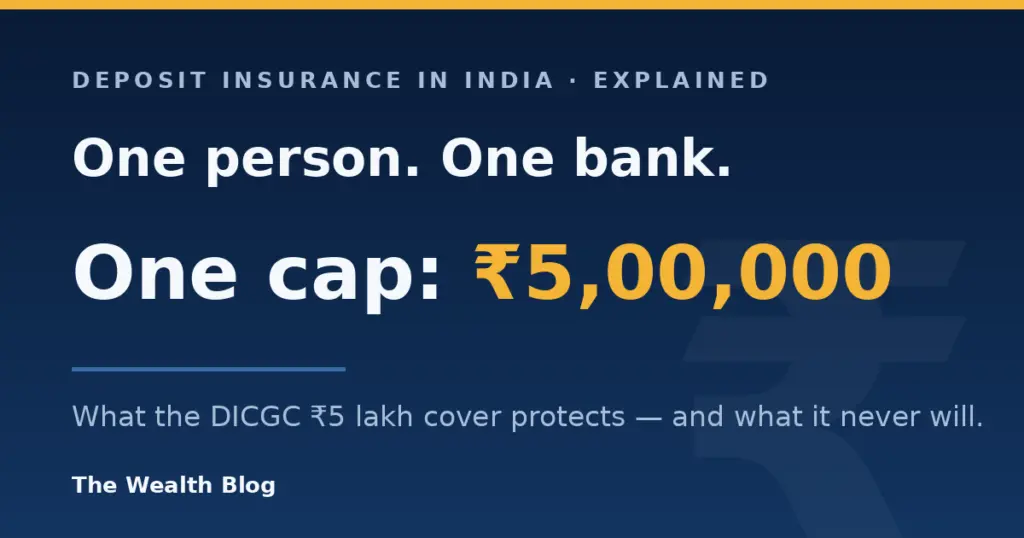
- Safety: Deposits up to Rs 5 lakh per bank are insured by DICGC, the RBI’s deposit insurance arm.
2. Current Account
This one is for businesses. Shopkeepers, freelancers with GST, startups, and professionals use it. It earns no interest but has no RBI-imposed transaction limit, which suits frequent business transactions.
- Who it’s for: Business owners, traders, startups.
- Minimum balance: Higher, usually Rs 5,000 to Rs 5 lakh.
- New rule (April 1, 2026): If your business has total banking exposure of Rs 10 crore or more, a bank can only give you a current account if it holds at least 10% of your total exposure. Otherwise you get a collection account only. Below Rs 10 crore, no restriction. (RBI Circular IDs 13222 and 13217)
3. Zero-Balance Account
A savings account where you don’t need to keep any minimum balance. The RBI requires banks to offer a Basic Savings Bank Deposit Account (BSBDA), a zero-balance option with free core facilities. You can keep Rs 0 and pay no penalty.
- Who it’s for: Students, first-time account holders, anyone who can’t maintain a high balance, or people who want a second account.
- Free stuff: RuPay debit card, at least 4 free withdrawals per month, passbook or e-statement.
- PM Jan Dhan (PMJDY): A special zero-balance account with Rs 2 lakh accident cover and overdraft up to Rs 10,000, available to eligible account holders after satisfactory operation. It’s a government scheme meant for financial inclusion, not promotion.
Best Savings Accounts in India – 12 Compared
Here are the top savings accounts with their real 2026 rates. Read the “slab” note carefully: the big headline number often applies only to large balances.
| # | Bank | Interest (p.a.) | Min Balance | Best For |
|---|---|---|---|---|
| 1 | SBI (BSBDA / YONO) | 2.50% | Rs 0 | Govt trust, 22,925 branches, 63,858 ATMs (Mar 2025 RBI data) |
| 2 | HDFC (Regular) | 2.50% flat (Rs 10,000 (metro)Full branch + product ecosystem | ||
| 3 | ICICI (Regular) | 2.50% flat (Rs 10,000App-first private bank | ||
| 4 | Axis (Regular) | 2.75% (₹50L threshold: 3.25% above ₹50L, Apr 2025 revision) | Rs 10,000-12,000 | Card + banking bundle |
| 5 | Kotak 811 (Digital) | 2.50% flat | Rs 0 | Students, digital-first, base for zero-fee credit card |
| 6 | IDFC FIRST (Pratham) | 2.50% up to Rs 3L; 6.50% above Rs 3L–25 crore; 5.00% above Rs 25 crore (w.e.f. 21 Apr 2026) | Rs 0 variants | High interest + zero fees on 28 services |
| 7 | AU Small Finance Bank | 2.50% under Rs 1L; 2.50% Rs 1–3L; 2.75% Rs 3–5L; 3.50% Rs 5–10L; 6.50% Rs 10L–25 crore; 6.75% Rs 25–100 crore (w.e.f. 1 Oct 2026) | Rs 2,000 | AA-rated; its 6.50% slab starts at Rs 10 lakh (min balance varies by variant; Rs 2,000 for the digital account) |
| 8 | Equitas SFB | 2.50% up to Rs 1L; 7.00% Rs 1–5L; 6.00% Rs 5–10L; 6.50% Rs 10L–25 crore; 7.00% above Rs 25 crore (w.e.f. 5 Aug 2026) | Rs 5,000 (zero variant available) | 7.00% on Rs 1–5 lakh; strong in South India |
| 9 | Jupiter (Federal Bank) | 2.50% uniform up to Rs 1 lakh (per jupiter.money fee schedule, 5 Sep 2026) | Rs 5,000 average monthly to avoid charges of up to Rs 300 | Pots auto-save, spend analytics |
| 10 | Fi (Federal Bank) | 3.00% (app winding down 2025-26, migrating to Federal) | Rs 0 | Salaried tech users (moving to Federal app) |
| 11 | Niyo (SBM / Equitas) | 3.50% (SBM) / NiyoX follows Equitas’ published savings slabs | Rs 0 | Zero forex markup, international travel |
| 12 | DBS Digibank | 2.50% (up to Rs 2L), 5.00% (Rs 2L-50L), 4.00% (above Rs 50L) | Rs 10,000 (MAB) | Best-in-class app, branch-averse users |
The slab trap: an “up to” number is not what your balance earns. AU SFB pays 2.50% on your first Rs 3 lakh and 3.50% between Rs 5 and 10 lakh — the 6.50% tier starts only at Rs 10 lakh, and 6.75% needs Rs 25–100 crore. Equitas is the mirror image: its best retail rate, 7.00%, applies only to the Rs 1–5 lakh band and then drops to 6.00% above Rs 5 lakh. Always check the slab your own balance falls in.
A note on Small Finance Banks (SFBs): AU, Equitas, and IDFC FIRST are RBI-regulated and DICGC-insured exactly like SBI. Your money is equally safe within the Rs 5 lakh limit. Unity SFB pays 7.00% only on balances above Rs 5 lakh (slabs w.e.f. 1 Aug 2026) — and ICRA downgraded Unity to A− on 1 July 2026 and withdrew its Unity ratings on 21 July 2026, so weigh that headline rate carefully. AU’s retail ceiling is 6.50% from Rs 10 lakh; Equitas’s 7.00% sits on Rs 1–5 lakh. We go bank by bank on whether your money is safe in a small finance bank.
Banks left out of this guide: Paytm Payments Bank had its banking licence cancelled by RBI on April 24, 2026 (RBI Release prid=62621) and no longer operates as a bank, so it isn’t listed as an option anywhere here. DBS Bank India has been a wholly-owned subsidiary of DBS Singapore since 2019. Always check a bank’s current regulatory status before opening an account.
Best Current Accounts for Business – 8 Compared
If you run a business, you need a current account. Here are the main options:
| # | Bank | Account | Min Balance | Best For |
|---|---|---|---|---|
| 1 | SBI | Regular Current | Rs 5,000 | Small biz, traders; 100L free cash/mo, 700 free cheques/mo |
| 2 | SBI | Interbank Current | Rs 5,00,000 | Large corporates; unlimited DD/RTGS |
| 3 | HDFC | Biz Lite+ | Rs 10,000-25,000 | Micro/small biz, local ops |
| 4 | HDFC | Activ | Rs 10,000 | Retail merchants, shopkeepers |
| 5 | HDFC | Max Advantage | Rs 2.5-5L | Turnover Rs 5 cr+ businesses |
| 6 | ICICI | Current Account | Rs 50,000 | Mid-size businesses |
| 7 | Kotak | Retail Current (CAPMS) | NIL (select variants) | Startups, sole proprietors |
| 8 | Axis | Current Account | Rs 10,000-25,000 | SMEs, proprietors |
What a current account is useful for:
- No RBI-imposed transaction limit, and it’s built for frequent business transactions
- Cheque book and demand draft facility
- Overdraft (the bank lends you money when your balance hits zero)
- GST compliance and tax payments
- Bulk vendor payments
For larger businesses: the April 2026 RBI rule (Circular IDs 13222 and 13217) says borrowers with Rs 10 crore-plus banking-system exposure can only hold a current account where the bank has at least 10% exposure share. Below that, no restriction. If your business is large, check this with your banker.
Best Zero-Balance Accounts in India – 10 Compared
You don’t need to park Rs 10,000 in a bank anymore. These accounts need Rs 0 minimum:
| # | Bank | Account | Interest | Best For |
|---|---|---|---|---|
| 1 | SBI | BSBDA | 2.50% | Rural / govt-benefit users; 22,000+ branches |
| 2 | Kotak 811 | 811 Digital | 2.50% | Students, instant video-KYC open |
| 3 | ICICI | Basic / iSave | 3.00% | Top private bank, zero balance |
| 4 | HDFC | BSBDA | 2.75% | Salaried, senior citizens |
| 5 | IDFC FIRST | Pratham (Zero) | 2.50% up to Rs 3L; 6.50% above Rs 3 lakh (w.e.f. 21 Apr 2026) | Highest interest, zero balance |
| 6 | Jupiter (Federal) | Jupiter Digital | 2.50% up to Rs 1 lakh | Expense tracking, budgeting (needs Rs 5,000 average monthly to avoid charges) |
| 7 | Fi (Federal) | Fi Savings | 3.00% | Salaried (migrating to Federal app) |
| 8 | Niyo (SBM/Equitas) | NiyoX | 3.50% (SBM) / Equitas slabs (NiyoX) | International travel, forex-free |
| 9 | AU SFB | Digital (Zero variant) | 2.50% up to Rs 3L; 3.50% Rs 5–10L; 6.50% from Rs 10 lakh (w.e.f. 1 Oct 2026) | High interest + zero balance |
| 10 | PM Jan Dhan | Jan-Dhan | 2.50% (SBI) | Unbanked / financial inclusion (govt scheme) |
About Kotak 811 and 811 Super: the standard Kotak 811 digital account earns 2.50% with no fees. Kotak also offers 811 Super (a premium tier of the same account), which earns 3.50-4.0% based on balance but charges Rs 499 per year. This article focuses on the standard free 811 account, but 811 Super is worth considering if you park more than Rs 1 lakh in the account. This article covers the standard 811 account that is fee-free.
Is a zero-balance account really free? RBI-mandated BSBDA/PMJDY accounts have no minimum balance and free core facilities (cash, 4 withdrawals/month, RuPay card, passbook). But SMS alerts, duplicate statements, or extra services may carry small fees. (RBI DBR.LEG.BC.No.47/09.07.005/2018-19)
One rule to remember: you can’t hold a BSBDA and a regular savings account at the same bank. If you open a BSBDA, your old savings account there must close within 30 days (or 60 with notice). You can still hold fixed deposits. (RBI Directions 2025)
Neobanks vs Traditional Banks: What You Must Know
Apps like Jupiter, Fi, and Niyo look like banks. They aren’t. They’re neobanks, and the money actually sits with a partner bank (Federal, SBM, or Equitas).
Why this matters:
- Jupiter and Fi run on Federal Bank (Jupiter also names CSB Bank among its partner issuers). Jupiter’s own fee schedule pays a flat 2.50% up to Rs 1 lakh — not the 7% some people expect. Only NiyoX (Equitas backend) and Freo (Equitas) sit on an SFB backend, so they follow that bank’s published slabs.
- DICGC cover sits with the partner bank. If you already have a fixed deposit at that partner bank, the Rs 5 lakh insurance limit is shared across all your deposits there.
- Fi Money is winding down (2025-26). Users are being moved to the Federal Bank app. If you use Fi, log in to see your migration timeline. Your money and balance will transfer to a Federal Bank account. Don’t open a new Fi account expecting long-term feature support.
- NiyoX (Equitas backend) is your best neobank bet for SFB-level slabs plus zero-forex international features — check Equitas’s current rate card before you switch.
- Jupiter stays stable on Federal Bank, though it earns only 2.50% on balances up to Rs 1 lakh.
The partner bank’s terms override the app’s marketing. Read the fine print.
How to Open a Bank Account Online
Opening an account now takes 5 to 10 minutes.
You need:
- Aadhaar card (linked to your mobile number)
- PAN card
- A smartphone with a camera (for video KYC)
Steps:
- Download the bank’s app or visit the website
- Enter Aadhaar, verify with OTP
- Complete video KYC (a short call with a bank rep)
- Deposit the initial amount (most zero-balance accounts need Rs 0 to Rs 2,000)
- Done. Your virtual debit card is active instantly.
Digital accounts (Kotak 811, Jupiter, Fi, Niyo, DBS, IDFC FIRST) open this way. Before full KYC (usually after a branch visit), some have balance caps. Kotak 811 caps at Rs 1 lakh pre-full-KYC.
Is Your Money Safe? DICGC Rs 5 Lakh Cover
Every bank account in India has a safety net.
DICGC insurance covers up to Rs 5 lakh per depositor per bank, and that includes principal plus accrued interest. If you have Rs 5 lakh in SBI, it’s fully insured. If you have Rs 10 lakh, split it across two banks.
Covered: savings, fixed, current, and recurring deposits.
Not covered: mutual funds, stocks, bonds, insurance policies.
That covers the basics, but the scheme has sharp edges. Our explainer on how the Rs 5 lakh DICGC cover really works walks through the pooling rule, claim timelines, and why parking exactly Rs 5 lakh per bank backfires slightly.
This applies equally to SBI and to Small Finance Banks. (RBI Press Release prid=49330, effective February 4, 2020)
Joint account note: In a joint account, each co-depositor gets a separate Rs 5 lakh insurance cover. So a joint account with two holders is insured up to Rs 10 lakh total.
Smart move if you have more than Rs 5 lakh: split it. For example, keep Rs 5 lakh in Equitas SFB and Rs 5 lakh in IDFC FIRST. Both are fully insured, both earn above a PSU bank’s 2.50%. Remember, DICGC covers principal plus accrued interest up to Rs 5 lakh per bank.
Want the full picture? We compare all four small finance banks side by side — ratings, rate slabs and all — in our guide to whether your money is safe in a small finance bank, including how to spread an emergency fund across them fully insured.
Tax on Savings Account Interest
A lot of people miss this. Interest from your savings account is fully taxable as “Income from Other Sources.
But you get a deduction:
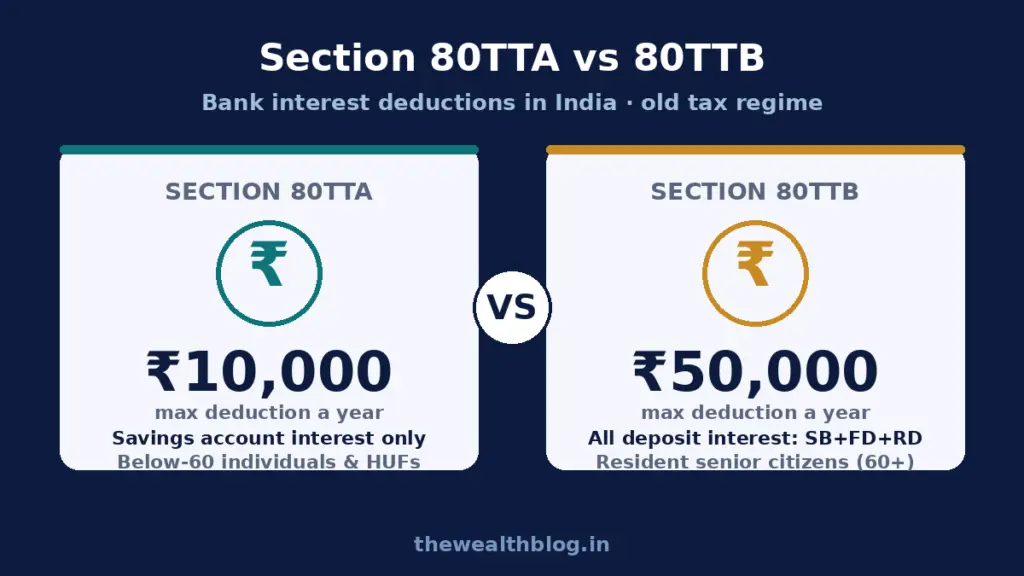
- Section 80TTA: Up to Rs 10,000 deduction on savings account interest (for those below 60), now numbered Section 153 of the Income-tax Act, 2025. Note: This applies only under the old tax regime; the new regime (default since FY 2023-24) does not allow 80TTA/80TTB deductions.
- Section 80TTB: Up to Rs 50,000 deduction for senior citizens (60+), also under Section 153 of the Income-tax Act, 2025. This covers interest from all deposits – savings, fixed deposits, and recurring deposits combined, not just savings. Note: This applies only under the old tax regime.
Example: you earn Rs 15,000 interest in a year. Below 60, you pay tax on Rs 5,000 (Rs 15,000 minus Rs 10,000). If you’re a senior citizen, the full Rs 15,000 is exempt.
Want the full breakdown of who can claim what and exactly how to file it? Read 80TTA vs 80TTB explained.
Retired, or helping parents plan? Our companion guide to senior citizen banking benefits lists the FD bonuses, SCSS rates and fee waivers worth claiming after 60.
The 4-Account Strategy
People who manage their money well tend to use four accounts:
1. Daily UPI account: Kotak 811 (zero balance) for payments and salary, or Jupiter if you want the spending analytics. Learn more in the Kotak 811 vs Jupiter comparison
2. High-interest savings: AU SFB or Equitas (each under Rs 5 lakh) for your emergency fund and surplus. See the AU SFB vs Equitas comparison
3. Salary / government linkage: SBI or a big bank for DBT, tax, and trust.
4. Emergency fund diversification: Spread across SFBs to stay within the Rs 5 lakh DICGC limit per bank. Check the DICGC coverage guide
Why four?
- No minimum-balance penalties
- Highest insured returns on idle money
- Daily spending kept separate from savings
- Emergency fund stays protected and accessible
The math: Rs 5 lakh in SBI at 2.50% earns Rs 12,500/year. The same Rs 5 lakh in Equitas SFB earns about Rs 30,500/year (1L at 2.50% plus 4L at 7.00%). That’s about Rs 18,000 extra every year, with the same DICGC cover.
Quick reference:
| Account Type | Recommended Bank | Purpose | Sub-Article Link |
|---|---|---|---|
| Daily UPI | Kotak 811 / Jupiter | Payments and salary | Kotak 811 vs Jupiter |
| High-interest savings | AU SFB / Equitas | Emergency fund and surplus | AU SFB vs Equitas |
| Salary / govt linkage | SBI / PSU bank | DBT, tax, trust | — |
| Emergency fund | Spread across SFBs | Diversified safety net | DICGC coverage guide |
Frequently Asked Questions
1. What is the difference between a savings and a current account?
A savings account is for personal use, earns 2.50-7.00% interest, and is built for regular day-to-day use. BSBDA accounts have restrictions on free withdrawals, but regular savings accounts don’t. A current account is for businesses, earns no interest, has no RBI-imposed transaction limit, and needs a higher minimum balance (Rs 5k-5L).
2. Which bank gives the highest savings interest?
Small Finance Banks lead, and which one is “highest” depends entirely on your balance: Equitas pays 7.00% on Rs 1–5 lakh but 6.00% on Rs 5–10 lakh, Unity pays 7.00% only above Rs 5 lakh (and ICRA downgraded it to A− on 1 July 2026, withdrawing its Unity ratings on 21 July 2026), and AU’s retail ceiling is 6.50% from Rs 10 lakh. Among private banks, IDFC FIRST goes up to 6.50%. Headline rates are slab-based, so check the slab, not the ad.
3. Is a zero-balance account really free?
RBI-mandated BSBDA/PMJDY accounts have no minimum balance and free core facilities. But SMS alerts, duplicate statements, or extras may carry fees.
4. Are my deposits safe? What is DICGC?
DICGC insures up to Rs 5 lakh per depositor per bank (raised from Rs 1 lakh in 2020). It covers savings, FD, current, and recurring deposits, not mutual funds or stocks. It applies equally to SFBs and big banks.
5. Can I open a savings account without visiting a branch?
Yes. Digital accounts (Kotak 811, Jupiter, Fi, Niyo, DBS, IDFC FIRST) open via Aadhaar/PAN video-KYC in minutes. Full-KYC limits lift after a branch visit.
6. Which account is best for students?
Kotak 811 (age 18+, no income proof, 2.50% interest, instant). Under 18: SBI Pehla Kadam (parental joint, government-backed).
7. What is BSBDA and PMJDY?
BSBDA is the RBI-mandated zero-balance account with minimum free facilities. PMJDY is the government Jan-Dhan scheme built on BSBDA, plus RuPay Rs 2 lakh accident cover and overdraft up to Rs 10,000.
8. Do neobanks like Jupiter and Fi give SFB-level 7% interest?
No. Jupiter and Fi run on Federal Bank, and Jupiter’s published rate is a flat 2.50% up to Rs 1 lakh — not SFB rates. Only NiyoX (Equitas backend) and Freo sit on an SFB backend. The partner bank’s terms override the app’s marketing.
9. Is savings interest taxable?
Yes, as “Income from Other Sources.” Deducted only up to Rs 10,000/year (Section 80TTA) or Rs 50,000 for seniors (Section 80TTB) — both now numbered Section 153 of the Income-tax Act, 2025, and both available only under the old tax regime.
10. What are the new April 2026 current-account rules?
Borrowers with banking-system exposure of Rs 10 crore or more can only hold current accounts where the bank has at least 10% exposure share; otherwise collection account only. Below Rs 10 crore, no restriction.
11. Which account is best for international travel or forex?
Niyo (zero forex markup, SBM/Equitas backend). Traditional bank debit cards charge about 3.5% cross-currency markup.
12. Can I have both a BSBDA and a regular savings account?
No, not at the same bank. A BSBDA holder can’t open another savings account there; the old one must close within 30 days (or 60 with notice). You may still hold term deposits.
13. Which bank has the widest branch and ATM network?
SBI: 22,925 branches and 63,858 ATMs (Mar 2025 RBI data). Best for rural, semi-urban, and government DBT.
14. Should I keep more than Rs 5 lakh in one bank?
No, not if you want full insurance. DICGC covers only Rs 5 lakh per bank. Split surplus across banks (e.g. Equitas SFB + IDFC FIRST, each under Rs 5L).
15. How do I choose between different bank account types?
Use the 4-account strategy: a daily UPI account for payments (Kotak 811 or Jupiter), a high-interest savings account for emergency funds (AU SFB or Equitas), a big bank for salary/government income (SBI or PSU), and emergency fund diversification across SFBs. Keep each account within the Rs 5 lakh DICGC limit.
16. What is the best strategy, one account or several?
Use Kotak 811 for daily UPI (zero balance) or Jupiter for its spending analytics, an SFB (AU/Equitas) for surplus savings (under Rs 5L each, higher interest), and SBI or a big bank for salary and government linkage. This avoids penalties and maximises insured returns.
Your Action Step Today
Open your banking app. Check the interest rate on your savings account.
If it’s below 3%, you’re leaving money on the table. Open a second zero-balance high-interest account (IDFC FIRST or AU SFB) and move your emergency fund there. Ten minutes of work. Around Rs 18,000 to 20,000 extra per year. Deposits up to Rs 5 lakh per bank are protected by DICGC.
Affiliate Disclosure
The Wealth Blog is an affiliate of Cuelinks and may earn a commission if you open an account through our links, at no extra cost to you. This does not affect our recommendations. We only list real 2026 rates and cite our sources. PM Jan Dhan is a government scheme and is covered for education only, not promotion. Always verify rates and fees on the bank’s official website before applying.
Sources (for verification)
- RBI BSBDA Directions 2025: rbi.org.in/Scripts/bs_viewcontent.aspx?Id=4733
- RBI Savings Deregulation 2011: rbi.org.in/Scripts/NotificationUser.aspx?Id=6779
- RBI Paytm Payments Bank licence cancellation (April 24, 2026): RBI Press Release prid=62621
- DICGC Deposit Insurance Guide: dicgc.org.in/guide-to-deposit-insurance
- PM Jan Dhan Yojana: pmjdy.gov.in/scheme
- AU Small Finance Bank, savings account interest rates (w.e.f. 1 October 2026): au.bank.in/interest-rates/savings-account-interest-rates
- Equitas Small Finance Bank, overall interest rates PDF (savings slabs w.e.f. 5 August 2026): equitas.bank.in — Overall Interest Rates
- IDFC FIRST Bank, savings account interest rates (w.e.f. 21 April 2026): idfcfirstbank.com — savings interest rate
- Unity Small Finance Bank, savings account interest rates (w.e.f. 1 August 2026): unity.bank.in — savings account
- ICRA, Unity SFB rating rationale, 1 July 2026 (downgrade to A−): icra.in; ICRA’s Unity ratings page, withdrawal 21 July 2026: icra.in
- Income-tax Act, 2025, Section 153 (interest on deposits — former Sections 80TTA and 80TTB): incometaxindia.gov.in/w/section-153-90
Disclaimer: This article is for educational purposes only and is not financial advice. Rates, fees, and features change. Verify everything on the bank’s official website before making a decision.