Retirees ask the post office clerk two different questions, and the answers pull in opposite directions.
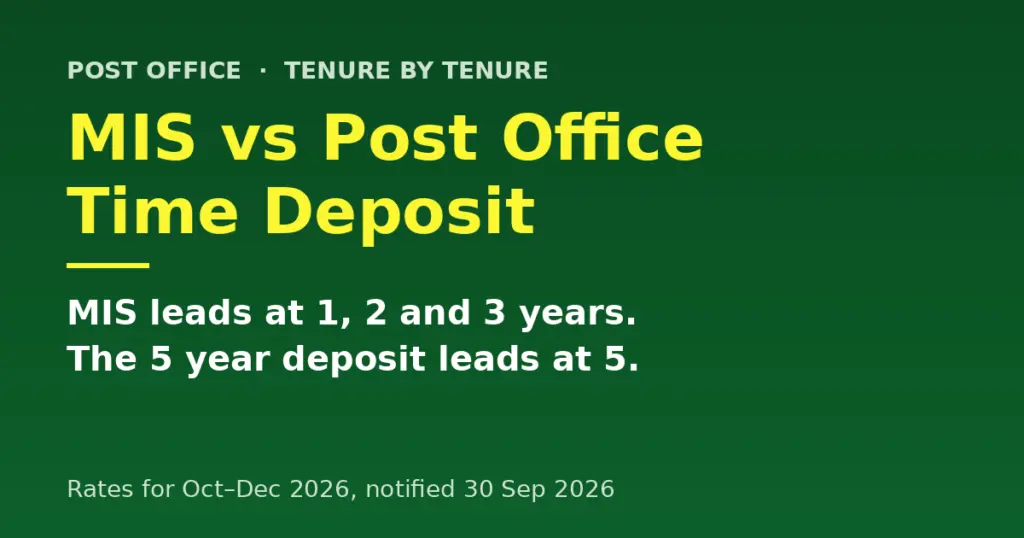
The first is “how much will I get every month?” The second is “how do I get the most interest on the money I already have?” MIS is built to answer the first. The Time Deposit is built to answer the second. On yield alone the answer is closer than the marketing suggests, and MIS actually earns more at one, two and three years. The Time Deposit earns more at five, and it locks its rate for the whole tenure. That second part is the real argument.
If you want the mechanics of MIS on their own, the MIS guide covers payout tables, the ceiling and the reinvestment question in depth. This page is the head to head, and it also covers a Post Office Time Deposit, which no other page on this cluster owns.
The rates, with the quarter on them
Every rate below is for 1 October to 31 December 2026, notified by the Department of Economic Affairs on 30 September 2026. The next revision is due on 31 December 2026. Post office rates move every quarter, so treat any rate you read without a date as out of date.
| Scheme | Rate for Oct to Dec 2026 | How it reaches you |
|---|---|---|
| MIS | 7.4% a year | Paid every month, for five years |
| Time Deposit, 1 year | 6.9% a year | Accrues quarterly, paid at the end of the year |
| Time Deposit, 2 years | 7.0% a year | Same |
| Time Deposit, 3 years | 7.1% a year | Same |
| Time Deposit, 5 years | 7.5% a year | Same |
| Post Office Savings Account | 4.0% a year | Computed monthly, credited once a year, and used as the fallback rate in some closures |
MIS pays a higher rate than the 1, 2 and 3 year Time Deposits, and a lower one than the 5 year deposit at 7.5%. That decides the yield comparison at one tenure out of four, which is why this page spends most of its space somewhere else.
What each one actually does
MIS takes one deposit and never takes another. Paragraph 4(1) of the National Savings (Monthly Income Account) Scheme, 2019 says the account opens with a minimum of ₹1,000 or a sum in multiples of ₹1,000, and “there shall be only one deposit in an account.” You cannot top it up in year three. Interest becomes payable on completion of a month from the date of deposit, and every month you get a fixed rupee amount that does not grow. At the end of five years you get the deposit back.
The Time Deposit works the other way round. Under the National Savings Time Deposit Scheme, 2019 you choose a 1, 2, 3 or 5 year tenure, make a single deposit of ₹1,000 or more in multiples of ₹100, and nothing is paid out until the tenure ends. Interest accrues on a quarterly basis within each year, is paid at the end of the year, and does not carry forward to earn more, which is what 7(7) provides for. Under 7(8) you can ask for the annual interest to be credited to your Post Office Savings Account instead of being withdrawn, which puts it somewhere it can earn while you wait.
Two things follow from that, and both matter more than the rate table.
A Time Deposit locks its rate for the whole tenure. MIS does not. Paragraph 7(4) says the rate applicable on the date of opening the account applies till maturity, and we put the numbers on that in a moment.
MIS is the only one of these three that pays you every month. The Time Deposit pays nothing until it matures, and a Post Office Savings Account computes its interest for a calendar month but credits it once a year, under paragraph 5(1) of its own scheme, so a deposit earning 4.0% for October to December 2026 still arrives as a single credit at the end of the year.
MIS income stops at month 60. A Time Deposit comes back as one lump sum at the end. For a retiree this is the difference between a fixed monthly number and a large one-off. One pays the electricity bill. The other pays a hospital bill.
The same money, two ways
Take ₹1,00,000. MIS at 7.4% pays ₹617 a month, which is ₹616.67 rounded to the nearest rupee as paragraph 5(4) requires. That is ₹7,404 a year and ₹37,020 over five years, plus ₹1,00,000 back at the end. MIS 5(3) is why nothing more than that accumulates: interest not claimed earns no additional interest, so the money leaves the account.
A Time Deposit pays you once a year and the money does not stay and earn. Interest builds up quarter by quarter through the year and is handed over at the year’s end, and once it has been paid it is gone rather than sitting inside the account earning its own interest. The next year starts again on the original deposit. That is 8(c), which calculates the completed year on quarterly compounding under paragraph 7, read with 7(2) for the quarterly basis and 7(7), which stops any unpaid interest earning once it falls due.
| On ₹1,00,000 | Time Deposit interest | MIS interest | Who leads, and by how much |
|---|---|---|---|
| 1 year at 6.9% | ₹7,081 | ₹7,404 | MIS by ₹323 |
| 2 years at 7.0% | ₹14,372 | ₹14,808 | MIS by ₹436 |
| 3 years at 7.1% | ₹21,874 | ₹22,212 | MIS by ₹338 |
| 5 years at 7.5% | ₹38,568 | ₹37,020 | Time Deposit by ₹1,548 |
MIS earns more at one, two and three years. The Time Deposit earns more at five. That is the honest shape of it and it is worth understanding why, because the reason is not compounding.
At one to three years the Time Deposit’s notified rate is lower than MIS’s 7.4%, and a few extra points of intra-year compounding do not make up the difference. At five years the 5 year rate is 7.5%, above MIS’s 7.4%, and that single notch is enough to put the deposit ahead. Switch on the yield argument alone and you would be building on a comparison that only works at one tenure out of four.
On ₹9,00,000, the ceiling for a single MIS account, the same shape holds: MIS leads by ₹2,875 at one year, ₹3,854 at two and ₹2,935 at three, and the Time Deposit leads only at five years, by ₹14,111. MIS pays ₹5,550 a month and totals ₹3,33,000, reaching ₹12,33,000. The 5 year deposit reaches ₹12,47,111.
Measured as a return on the final amount over five years, MIS gives you 6.502% a year and the 5 year Time Deposit gives you 6.741%. Both sit below the rates printed at the top of this page, 7.4% and 7.5%, and that is not an error. In both schemes the interest leaves the account instead of earning its own interest, so you never get the benefit of a second year on the first year’s interest. That is the whole shape of the comparison, and it is why these two numbers are close together rather than far apart.
The argument that does decide it
Rate locking. Paragraph 7(4) says the rate applicable on the date of opening the account applies till maturity. A 5 year deposit opened in October 2026 earns 7.5% for all five years, whatever the government does at the next quarterly review.
MIS has no such clause. Its monthly payout follows the rate notified for the quarter in which the interest is credited, so a single notification can change what an existing account pays. Set that against the deposit’s ₹1,548 advantage at today’s rates on a lakh, and one downward revision of MIS from 7.4% to 5.5% moves the five year total from ₹37,020 to ₹27,480. That is ₹9,540 of rate risk on the same ₹1,00,000, against the ₹1,548 the deposit actually wins at today’s notified rates. It is the larger number, and it is the one that matters for anyone whose money is not already spent.
Which way that cuts depends on where rates go, and nobody knows that in advance. What you can know today is that one scheme promises you a number for five years and the other does not.
Tax: same treatment, different relief
Both interests are taxable. Neither is exempt. The exemption under section 11(1), Schedule II, Sl. No. 11 of the Income-tax Act, 2025 covers interest on savings certificates and deposits notified by the Central Government, and MIS and Time Deposit interest are not in that set. Nothing to claim there, and no TDS exemption either.
What both get is the deduction for interest on deposits under section 153, which replaces the old 80TTA and 80TTB:
- Senior citizen: up to ₹50,000 on interest from deposits in any account, including time deposits. A Time Deposit holder gets the same relief as an MIS holder here.
- Not a senior citizen: up to ₹10,000 on interest from deposits in a savings account, excluding time deposits. Time Deposit interest is plainly outside that. MIS interest is inside it only if an MIS account counts as a savings account here, which the scheme text does not settle, so treat the ₹10,000 as likely rather than certain until you have confirmed it.
A person of 60 or above gets ₹50,000 of relief on the interest from either account. Someone under 60 is in a different position, and it is the mirror image: Time Deposit interest falls outside the ₹10,000 outright, and MIS interest falls inside it only if an MIS account counts as a savings account, the same question the bullet above raises. Neither deposit qualifies for a deduction under section 123, so there is nothing to combine it with.
If that ₹10,000 matters to your return, get it in writing. Rule 27 of the Government Savings Promotion General Rules, 2018 makes the Department of Economic Affairs the competent authority on questions of interpretation, and its view is final and binding, so a ruling from them settles it where reading the gazette cannot. Ask the post office which authority can give you one, and keep the answer with your paperwork for the year you claim.
TDS applies to both interests unless a valid Form 15G is on file. The SCSS interest and TDS page sets out the thresholds and the forms.
Getting your money back early
This is where the two schemes are least alike.
MIS may be closed after one year, at the accounts office’s discretion. Closing on or before three years costs 2% of the deposit. Closing after three years costs 1%. On ₹9,00,000 that is ₹18,000 or ₹9,000 out of your principal, and you cannot appeal that decision. There is no penalty-free exit in the scheme text.
The Time Deposit cannot be touched in the first six months at all. After six months but before one year, interest is paid at the Post Office Savings Account rate for the completed months. On ₹1,00,000 held for eight months that works out to ₹2,666, against ₹7,081 if you had let it run the full year.
After one year, on a 2, 3 or 5 year account, interest is recalculated at a rate two percentage points lower than the notified rate for the account, compounded quarterly for completed years, with any part year at the savings account rate. Here is the sting. On a 3 year Time Deposit of ₹1,00,000 closed at 18 months, the recalculated interest is ₹5,198 for the completed year at 5.1%, plus ₹2,000 for the six months at 4.0%, the savings account rate for October to December 2026, so ₹7,198 against ₹7,291 already credited at the full 7.1% in the first year. Any interest already paid is recovered from the repayment, so on that arithmetic the recovery swallows everything and the closure returns close to your principal and nothing more.
That odd result turns entirely on the rate applied to the six month part of the year, and 8(b) points to the savings account rate, 4.0% for October to December 2026. Work it the other way, at the reduced 5.1% instead, and the part-year comes to ₹2,550 rather than ₹2,000, the total comes to ₹7,748 rather than ₹7,198, and that is more than the ₹7,291 already credited, so nothing gets recovered and the deposit pays out normally. If you work this out for yourself, use the savings account rate in force when you close, and check it first — 4.0% is the rate for October to December 2026 and it is revised every quarter, so a figure worked out today is not a rule you can reuse later.
We could not find a worked example from the department to confirm which figure it would actually pay, so treat this as the rule working out loud rather than a quote, and ask your post office for the number on your own account before you rely on it. One last thing, since 4.0% is only the rate for October to December 2026: the savings account rate moves every quarter like everything else here. These figures land ₹93 short of the ₹7,291 credit, so a rise of about a fifth of a percentage point at the next revision would flip the result and the two readings would agree. Check the live rate before you rely on any of it.
On a 5 year account closed after four years, the scheme says the rate admissible for a 3 year Time Deposit applies. Ask what that works out to on your balance.
A Time Deposit can also be pledged or transferred as security under paragraph 9, to a bank, a cooperative society, a public or private corporation, a local authority or an NHB-approved housing finance company. The MIS scheme text contains no pledging paragraph at all. If you borrow against a fixed deposit, that is available to you and it is not available to an MIS holder.
Laddering, the option MIS does not offer
A Time Deposit has an extension clause and MIS does not. When a deposit becomes due for repayment, the holder may extend the account for the same tenure again, and can do it twice after the first repayment date. The window to exercise it is six months for a 1 year account, twelve months for a 2 year account, eighteen months for 3 and 5 year accounts. You can even opt for the extension when you open the account, and revoke it any time before repayment. The extension earns whatever rate applies on the date of repayment, not the rate you opened at.
So a retiree who wants income later rather than now can build a ladder: one Time Deposit maturing each year, and only the tranche that matures gets rolled or spent. MIS cannot do this. Its income is either on now for five years, or gone.
Who should pick which, and at what tenure
Pick MIS when the monthly number is the point. You need a fixed amount every month, you are not going to reinvest it, and you would rather not manage a maturity date. MIS also happens to earn more at one, two and three years, so a shorter horizon is where the two schemes are genuinely close.
Pick the 5 year Time Deposit when this money is for later and you can leave it alone. It is the only tenor where the deposit wins on yield, and it comes with a rate locked for the full five years, no ceiling on what you can put in, and an account you can pledge. You can still turn it into monthly income afterwards by reinvesting each year’s interest in an MIS account.
Pick the 1, 2 or 3 year Time Deposit if you want the rate lock and the pledgeability but not a five year wait, or if you are weighing a post office deposit against a bank one and want the two compared side by side, which the SCSS against bank FD guide does. You will give up ₹323 to ₹436 per lakh of interest against MIS over those tenures, which is a modest price for knowing the rate.
Pick both if you can afford it. A common shape for a retiree is a smaller MIS account for the monthly and a Time Deposit for the rest, and since MIS caps out at ₹9,00,000 single or ₹15,00,000 joint, the second pot is usually the larger one.
Risks, stated plainly
- Rates change every quarter. The 7.4%, 6.9%, 7.0%, 7.1% and 7.5% on this page apply to October to December 2026 only.
- Inflation eats both. If prices rise faster than 6.5%, the real return on either scheme is negative, and no rate table changes that.
- MIS income stops at the end of five years unless you reinvest, and reinvesting means making a decision sixty times.
- Early exit from either scheme costs money, and the MIS cost is a percentage of the whole deposit.
- A Time Deposit locks its rate; MIS does not. A single downward revision can move more money over five years than the entire yield advantage of the deposit.
- MIS interest is taxed as it is credited, month by month, so a large balance produces a monthly tax bill even in a year you need the money for something else.
- If MIS or a Time Deposit is one part of a wider retirement plan, the senior citizen savings and pension hub pulls the other schemes onto the same page.
- Post office schemes are backed by the Government of India. That is not the same as a deposit insurance guarantee, and the DICGC guide sets out what is and is not covered.
What to do today
- Write down your monthly number. If you cannot state the amount you need each month, do not open an MIS account yet.
- Open a Post Office Savings Account if you do not have one. MIS payouts and Time Deposit interest both need somewhere to land, and at 4.0% for October to December 2026 it is not a bad parking spot.
- Put a small sum in a 1 year Time Deposit first. It is the shortest lock in this comparison and it tells you what the post office will actually pay you.
- If you do open MIS, treat the principal as gone for five years and the monthly amount as your income, not as savings.
- Set a diary reminder for 31 December 2026. Both schemes will have new rates that day, and a MIS holder who does not check will budget on a number that no longer exists.
Key takeaways
- MIS earns more at one, two and three years. On a lakh, MIS is ahead by ₹323, ₹436 and ₹338. At five years the 5 year Time Deposit leads by ₹1,548, because 7.5% beats MIS’s 7.4% and compounding does not close the gap.
- Over five years on a lakh, MIS returns 6.502% a year on the final amount and the 5 year deposit returns 6.741%, both below their notified rates because in each scheme the interest leaves the account instead of earning its own interest. The gap between the two is small.
- The real argument is rate locking. A Time Deposit holds its opening rate till maturity. MIS tracks the notified quarterly rate, and one revision from 7.4% to 5.5% is ₹9,540 on a lakh over five years, against the deposit’s ₹1,548 advantage at today’s rates.
- MIS ceiling is ₹9,00,000 single and ₹15,00,000 joint, aggregating across all your own accounts. A Time Deposit has no ceiling and no aggregate.
- MIS interest is taxable, and section 153 relief is up to ₹50,000 for a senior citizen on any account including time deposits. For anyone under 60 the cap is ₹10,000 on savings accounts with time deposits excluded, so MIS depends on whether it counts as a savings account, which is worth confirming.
- Early exit is costly in both. MIS costs 2% within three years and 1% after. A Time Deposit cannot be closed in six months and recalculates interest at two percentage points lower.
- A Time Deposit can be pledged as security and extended twice. MIS cannot be pledged under its scheme text and has no extension clause.
- Income stops at month 60 on MIS unless you reinvest it.
Questions people ask
Which gives more interest, MIS or a Post Office Time Deposit?
It depends on the tenure. On ₹1,00,000, MIS earns ₹7,404 in the first year against ₹7,081 for a 1 year deposit, ₹14,808 against ₹14,372 over two years and ₹22,212 against ₹21,874 over three. The Time Deposit wins only at five years, ₹38,568 against ₹37,020, because its 7.5% rate is above MIS’s 7.4% and the shorter tenures are not. Over five years MIS returns 6.502% a year on the final amount and the deposit 6.741%. Rates are for October to December 2026.
Can I add more money to an MIS account later?
No. Paragraph 4(1) of the MIS scheme says there is only one deposit in an account. The ₹9,00,000 single or ₹15,00,000 joint ceiling is a ceiling on what you deposit once, and it aggregates across all of your own MIS accounts. You cannot top it up in year three.
Is there a limit on how much I can put in a Time Deposit?
No. Paragraph 4(2) of the Time Deposit scheme says an individual may have more than one account in his name or jointly with another, and no amount is specified anywhere in the scheme. There is no aggregate cap either.
Does a Time Deposit pay me anything before it matures?
Not out of the account. Interest accrues quarterly through the year and is paid at the end of it, and paragraph 7(7) stops that interest earning anything once it falls due. Paragraph 7(8) lets you ask for the payout to be credited to your Post Office Savings Account instead of withdrawn, which puts it somewhere earning at 4.0% for October to December 2026 rather than leaving it idle. Until maturity the deposit itself is yours, but it is not spendable.
What happens to my MIS monthly income after five years?
It stops. At maturity you get the deposit and accrued interest, and there is nothing automatic after that. Reopening an MIS account on the returned amount is the usual route, and it means deciding whether the new rate is worth the new five year lock.
Which post office deposit gives monthly income?
MIS is the only one of these three that pays you every month. A Time Deposit pays nothing until it matures, and a Post Office Savings Account computes its interest for a calendar month but credits it once a year, at 4.0% for October to December 2026.
Is MIS better than a time deposit for retirees?
For a fixed five year pot that is not being spent, yes on the numbers, by ₹1,548 on a lakh, and the deposit’s rate is locked for the whole five years while MIS’s is not. For money you need monthly, MIS pays you monthly and the Time Deposit pays you nothing at all until it matures, and at one, two and three years it also earns a little more. Neither is better in general, and the tenure is what decides it.
Is a Time Deposit safe to borrow against?
The scheme allows it. Paragraph 9 lets an account be pledged or transferred as security to a bank, cooperative society, corporation, local authority or an NHB-approved housing finance company. The MIS scheme text contains no pledging provision.
Sources
- National Savings (Monthly Income Account) Scheme, 2019, G.S.R. 917(E) dated 12.12.2019, as amended by G.S.R. 286(E) dated 05.05.2020 and G.S.R. 239(E) dated 31.03.2023. Paragraphs 3(1), 3(2), 4(1), 4(2), 4(3), 5(2), 5(3), 5(4), 6, 7(1).
- National Savings Time Deposit Scheme, 2019, G.S.R. 922(E) dated 12.12.2019, as amended by G.S.R. 289(E) dated 05.05.2020. Paragraphs 4, 5(1), 5(2), 6, 7(2), 7(4), 7(5), 7(7), 7(8), 8(a) to 8(d), 9. The intra-year quarterly accrual and the annual payout that every Time Deposit figure rests on is 8(c), read with 7(2) and 7(7).
- Government Savings Promotion General Rules, 2018, rule 4 and rule 27.
- Department of Economic Affairs, Ministry of Finance, Office Memorandum dated 30.09.2026, rates for the third quarter of FY 2026-27. Reported in ThePrint (PTI) and Business Standard, 30.09.2026.
- Income-tax Act, 2025, section 11(1) Schedule II Sl. No. 11, section 153.
Education only, not personal advice. Check the live rate on the India Post or National Savings Institute site before you deposit anything.
Affiliate disclosure: this page may earn a small commission if you open an account through a link on this site. That does not change what we write, and it cannot change a notified interest rate.
This page is a comparison, not a recommendation. The decision depends on your savings, your income needs and your health, none of which this article knows.
Related reading on this site. all seven small savings schemes; the Post Office Savings Account; NSC against KVP; TDS on post office interest; SCSS interest, tax and 80TTB.