Last updated: August 2026
You are in the basement of your kirana shop. No network bars. The payment screen spins and spins. Finally you hand over cash and mumble something about paying later.
There is a UPI feature built for that exact moment. Fewer than one in a hundred UPI payments runs through it.
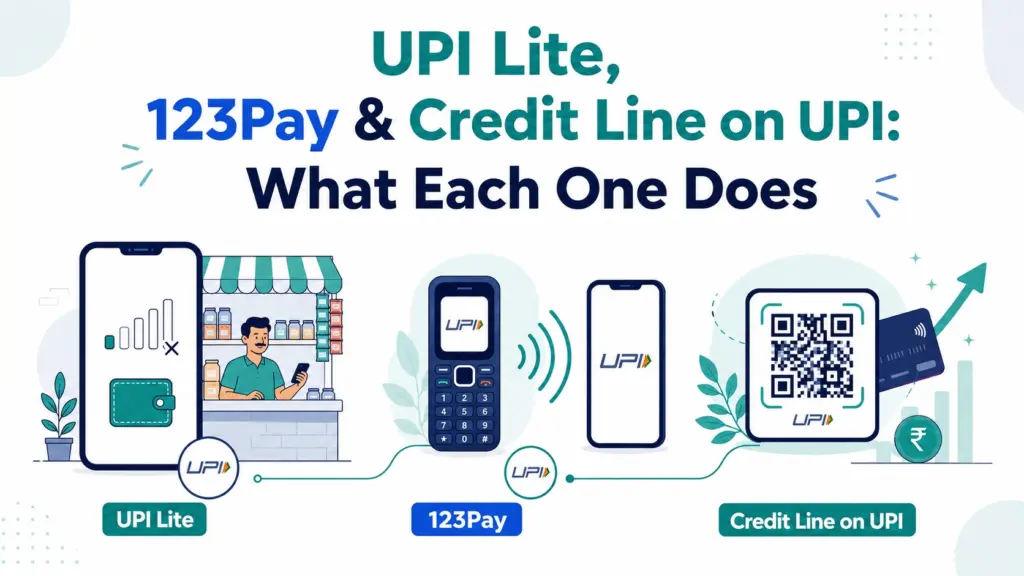
It is not the only quiet addition either. UPI now has three lesser-known features, and each solves a different problem. UPI Lite handles small payments when the network is weak. UPI 123Pay works on basic keypad phones. Credit Line on UPI lets a bank lend to you right inside the payment app.
Two of these save you friction. One puts debt in your pocket. Worth knowing which is which before you tap anything.
Quick answers
- UPI Lite: ₹1,000 per transaction, ₹5,000 maximum wallet balance, ₹10,000 total spending per day.
- UPI 123Pay: ₹10,000 per transaction, no internet needed, UPI PIN mandatory every time.
- Credit Line on UPI: a pre-approved bank loan linked to your UPI. You repay it like any loan, and missed payments reach your credit bureau.
- UPI Lite refunds: they go to your bank account, never back into the Lite wallet.
Why this matters now
Banks and apps have been pushing these features hard for two years, and the rules around them keep moving. Limits were raised in late 2024. New protections arrived through 2025. In June 2026, the Reserve Bank of India (RBI) formally classified credit on UPI as ordinary lending for regulatory purposes.
Most articles stop at the marketing pitch. The details matter more: where refunds land, whether you earn any interest, what happens when you lose your phone, and what a missed payment does to your credit score.
One honest note before we start: adoption of these features is still small next to mainstream UPI.
Now, each feature in plain words.
UPI Lite: pocket change that lives on your phone
What it is
UPI Lite is a small wallet carved out of your own bank account and stored on your phone. You move, say, ₹500 from your savings account into Lite. After that, small payments work even when the signal struggles.
Normal UPI asks your bank’s server to approve every payment. Lite skips that step. Your phone records the debit on the spot and syncs with the bank later. So a dead zone in that basement stops being a problem. Scan the QR, pay, walk out. No PIN needed either.
The National Payments Corporation of India (NPCI), which runs UPI, launched it in September 2022. One clarification people miss: payments are near-offline, not fully offline. Loading money, topping up and receiving refunds still need connectivity. For truly offline payments there is a sibling called UPI Lite X (September 2023), which works through NFC taps between two phones.
Who it is genuinely for
People who make many small payments: autos, chai, milk, sabzi, canteen lunch. It shines in basements, lifts, packed markets and trains, anywhere the signal drops right when you need to pay.
How to start using it
Open your UPI app and look for “UPI Lite” under your profile or payment settings. Activate it and load money using your UPI PIN. Your bank and app must support it; most large ones do now.
Many apps also offer an auto top-up. It runs on a UPI AutoPay mandate, allowed since August 27, 2024. When your Lite balance falls, the app refills it automatically. NPCI caps this at five refills a day, so it cannot quietly drain your account in a loop.
Current UPI Lite limits (2026)
As of 2026, UPI Lite limits are:
Per transaction: ₹1,000. Maximum wallet balance: ₹5,000. RBI announced the raise in October 2024, made it official through a December 4, 2024 amendment to the Offline framework, and NPCI implemented it in February 2025. Earlier caps were far lower, just ₹200 per transaction at launch.
And across a full day, total Lite spending is capped at ₹10,000, even if individual payments are smaller.
UPI Lite X runs tighter limits: ₹500 per tap, ₹2,000 wallet, ₹4,000 per day, with NFC switched on at both ends.
The catches nobody advertises
No. Refunds never return to the Lite wallet. Return a shirt, and the money lands in your bank account. NPCI’s rules are explicit about this.
Lite money earns zero interest. It sits outside your savings balance until you move it back. Small amounts, small loss, but a loss all the same.
Treat it like cash in your pocket. Switching phones? Disable Lite on the old one first. Lose a loaded phone, and the bank may refund after verification. May, not must.
Your bank statement stays clean too. Lite payments do not show up item by item. You get a daily summary SMS and in-app history instead, so reconcile spending there.
Two fixes worth knowing. Since April 1, 2025, a “Transfer Out” option pulls unused balance straight back to your bank account without switching Lite off. And banks were required to refund dormant wallets, unused for six months, by June 30, 2025.
UPI 123Pay: UPI for keypad phones
What it is
Around 40 crore Indians were still using feature phones when this launched, per RBI’s March 8, 2022 announcement. UPI 123Pay brings payments to them in four modes: an app made for feature phones, a missed call to the merchant followed by a callback where you enter your PIN, an IVR call with a voice menu, and a sound-based mode where two phones trade payment details through audio tones.
None of these need mobile internet. Any phone that can make calls works. The interface comes in 12 languages, according to RBI.
Who it is genuinely for
Parents and grandparents on basic phones. Anyone who finds smartphone apps confusing. If you manage money for an elderly relative, this is the bridge.
How to start using it
The mobile number registered with the bank does the heavy lifting. Set a UPI PIN once and the account is ready. The bank must be live on 123Pay, and coverage differs by bank.
The IVR route works well for elders: call the IVR number your bank publishes, follow the voice menu, enter the payee’s number, the amount and the PIN. NPCI has reportedly run live pilots, like booking Archaeological Survey of India monument tickets over a simple phone call.
Current UPI 123Pay limits (2026)
₹10,000 per transaction, doubled from ₹5,000 in October 2024. RBI announced it on October 9, 2024; NPCI directed member banks to implement immediately, with compliance due January 1, 2025. The same circular moved onboarding to Aadhaar-OTP verification.
The catches nobody advertises
Every transaction needs your UPI PIN. “No internet” is true. “No PIN” is not.
Voice channels leak. Someone standing close can hear or see a PIN keyed in during a call. Teach elders to shield the keypad and never share the PIN with any “helper” on the line.
Quality depends on each bank’s rollout, and IVR lines are not immune to downtime.
Credit Line on UPI: borrowing built into the QR
What is Credit Line on UPI?
Since September 4, 2023, RBI has let banks attach a pre-approved credit line to your UPI. Think of it as a third funding account sitting next to your savings account. You pay a merchant by QR as usual, but the money comes from the bank’s credit line instead of your balance.
It is a loan wearing a payments uniform. The bank sets your limit, interest rate, repayment schedule and fees under its board-approved credit policy. You approve by binding your device and setting a separate UPI PIN. The bank must also tell the merchant that the payment was made via credit line.
Only scheduled commercial banks can issue these. Payment banks and regional rural banks cannot. Small finance banks were allowed in from February 12, 2025.
Credit Line on UPI: who is eligible?
Pre-approved customers only. The bank picks who gets an offer; there is no open application window. Small banks moved first, often pairing with fintech apps, since it let them lend without issuing cards. Large banks joined much later than the small ones.
As of January 2026, fifteen scheduled commercial banks plus two small finance banks offered credit lines on UPI, per NPCI website data reported by Financial Express.
How to start using it
If your bank offers it, the invite usually appears inside your UPI app as a “pre-approved credit line” with a stated limit. Accepting binds your device, sets a UPI PIN for the line and agrees to the bank’s terms. No offer in your app usually just means you are not among the selected customers yet.
Credit Line on UPI: what it costs, and who pays (2026)
Merchants pay an interchange fee on these transactions, fixed by NPCI from October 16, 2024: 1.2% on interest-free credit line payments for most merchant categories, and zero on payments up to ₹2,000 at small offline merchants. You pay nothing at the counter.
The real cost hides in the product terms: interest rate, late fees, processing charges. Judge the offer on those, not on the smooth checkout experience.
Scope widened in July 2025. Banks may now offer interest-bearing credit lines, and may permit cash withdrawals or person-to-person transfers from a line, but only if their own credit policy allows it, and always within the purpose for which the loan was sanctioned.
The catches nobody advertises
This is a real loan. RBI’s June 23, 2026 directions removed all doubt: capital, provisioning and bad-loan rules for credit on UPI are identical to normal loans.
Your credit report is watching. Late payments and defaults get reported like any other borrowing. A few missed repayments on small pharmacy bills can bruise a score built over years.
Interest-free is not guaranteed. Some variants give roughly a 45-day window and work like a charge card. Interest-bearing variants start charging from day one. Know which one you accepted.
Repayment is usually automatic, through auto-debit on your bill cycle. Keep the funding account funded on the due date.
And merchants can refuse. Above ₹2,000, the interchange makes some small shops decline credit-line payments. Do not assume every QR code accepts it.
UPI Lite vs 123Pay vs Credit Line on UPI: side by side
| UPI Lite | UPI 123Pay | Credit Line on UPI | |
|---|---|---|---|
| Phone needed | Smartphone | Any phone, including keypad | Smartphone |
| Internet needed | Only to load money; payments work without network (synced later) | None | Yes |
| UPI PIN | Only for loading money | Every payment | Every payment |
| Where money comes from | Your bank balance, parked on the device | Your bank account directly | Bank’s pre-approved loan |
| Max per transaction | ₹1,000 | ₹10,000 | Bank decides per customer |
| Overall cap | ₹5,000 wallet | No separate daily cap published; per-transaction limit governs | Set by the issuing bank |
| Cost to you | No fee, but no interest earned | No fee | Interest and fees depend on the variant |
| Biggest catch | Refunds bypass the wallet; no interest | PIN can be overheard on calls | It is a loan; defaults hit your credit report |
Limitations of UPI Lite, 123Pay and Credit Line on UPI
Lite shifts risk onto your device. The balance behaves like cash, and recovery after a theft depends on the bank’s verification, not a guarantee. It also keeps detail out of your bank statement, so check the app history rather than assuming the passbook tells the whole story.
123Pay concentrates fraud risk on the voice channel and depends on uneven bank-by-bank rollout.
Credit lines can turn a payment habit into a borrowing habit. The offer screen shows a generous limit, never the interest math. Merchant acceptance is spotty above ₹2,000.
None of the three replaces an emergency fund sitting in a savings account.
Myths worth deleting
- “UPI Lite works without internet.” Partly. Payments do. Loading, topping up and refunds need connectivity. Truly offline is Lite X with NFC.
- “Lite is a separate wallet like standalone wallet apps.” No. It is your own bank money parked on your phone, linked to one bank account per app.
- “Lite balance earns interest like savings.” Zero.
- “Refunds come back to Lite.” They go to your bank account.
- “Credit Line on UPI is the same as RuPay credit card on UPI.” Different products. A credit line is a loan linked as a funding account; a RuPay credit card is a card instrument. Headlines mixing the two inflate the apparent size of both.
- “A credit line is free money until repayment.” Only some variants have an interest-free window. Others charge from day one. Either way, it reports to your credit bureau.
- “You can pay anyone with a credit line, like normal UPI.” Mostly merchant payments. Person-to-person transfers and cash withdrawals work only where the issuing bank allows.
- “The new authentication rules from April 2026 killed PIN-free Lite.” Wrong. RBI’s September 25, 2025 authentication directions exempt small-value offline digital payments, so Lite stays PIN-free for payments. Several reports got this wrong.
What you can do today
Open your UPI app and check which of the three features your bank actually supports. Find UPI Lite in settings and load a small amount you would not miss; use it the next time the network acts up. That one check tells you more than any article.
Two follow-ups for this week, if they apply to you. Call a parent with a keypad phone, ask whether their bank is live on 123Pay, and walk them through setting a UPI PIN, with a warning about sharing it on calls. And if a pre-approved credit line offer is sitting in your app, read the interest rate, fees and repayment date before touching accept. Assume it will reach your credit report, because it will.
Before selling or swapping your phone, move your Lite balance out or disable Lite first.
Key takeaways
- UPI Lite is your own money parked on your phone for small payments in weak-network spots. No interest, refunds bypass it, guard it like cash.
- UPI 123Pay is UPI without internet for keypad phones. The UPI PIN is still mandatory, every time.
- Credit Line on UPI is a pre-approved bank loan attached to your QR payments. Smooth at checkout, unforgiving if you miss repayments.
- None of the three charges you for making a payment; the real costs sit in the credit line’s interest and fees, and in merchant acceptance.
- Limits and rules changed repeatedly between 2022 and 2026. Verify current figures on RBI and NPCI pages before acting on older advice.
This article is for education only, not personalized financial advice. Terms vary by bank. Consult a qualified financial adviser before deciding to borrow.
Primary sources behind the numbers
- RBI press release, Oct 9, 2024: limit enhancements for UPI Lite and 123Pay
- RBI circular, Dec 4, 2024: amendment to the Offline framework (Lite ₹1,000 per transaction, ₹5,000 wallet)
- RBI press release, Mar 8, 2022: UPI 123Pay launch and four modes
- RBI circular, Sep 4, 2023, updated Feb 12, 2025: pre-sanctioned credit lines via UPI
- RBI amendment directions, Jun 23, 2026: prudential parity for UPI-linked credit
- RBI authentication directions, Sep 25, 2025: exemptions for small-value offline payments
- NPCI circulars: OC-138 (Lite launch, including the ₹200 per-transaction limit), OC-205 (auto top-up), OC-169-A (Feb 2025 Lite changes and dormant refunds), Oct 25, 2024 (123Pay limits), OC-202 (credit line interchange, Oct 16, 2024), Sep 20, 2023 operating circular and Jul 10, 2025 addendum (credit line operations)