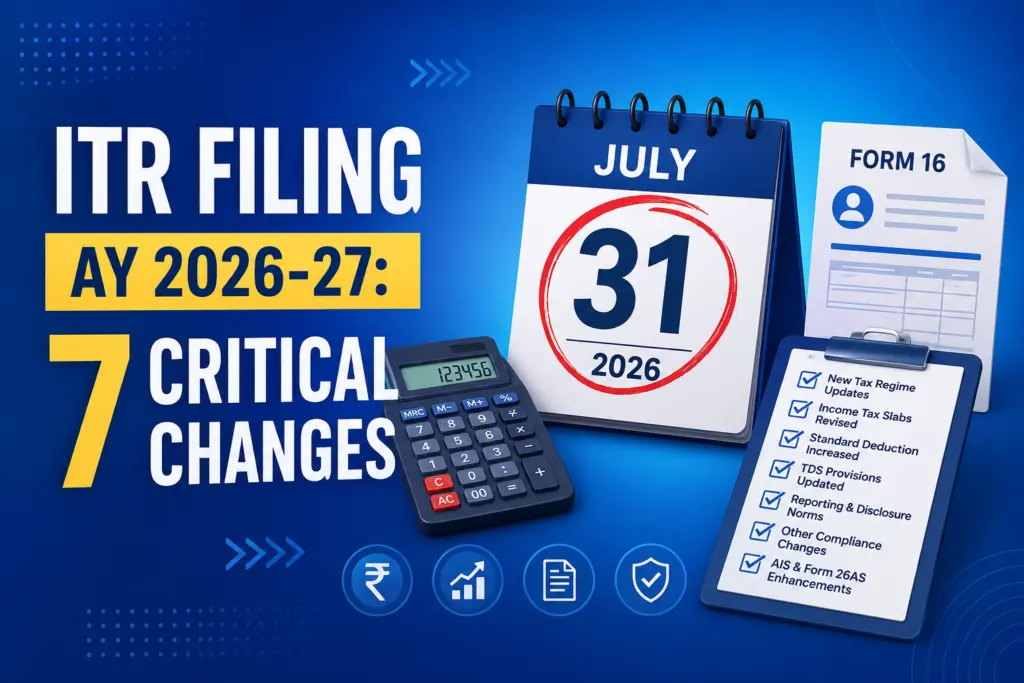
The ITR filing window for AY 2026-27 is open. If you’re salaried, your deadline is July 31, 2026. That gives you about 40 days.
But here’s the thing — this isn’t a normal filing season. AY 2026-27 is the transition year between the old Income Tax Act, 1961 and the new Income Tax Act, 2025. Things are different this time. Here are the 7 changes you absolutely need to know.
Change 1: Dual-Act Transition Year
This is the biggest change.
The Income Tax Act, 2025 started on April 1, 2026. But here’s the twist: for income earned up to March 31, 2026 (which is what you’re filing now), the old 1961 Act still applies. From next year (returns filed in 2027), everything moves to the new Act.
Practical takeaway: For this year’s filing, use the same forms and rules you’re used to. But be aware that both Acts run side by side on the e-filing portal. Make sure you’re filing under the right tab when paying self-assessment tax — use Tab 1 (1961 Act), not Tab 2.
Next up is another change that affects how you read your TDS certificates.
Change 2: TDS/TCS Restructuring — New Section Numbers
This one matters more if you run a business, but here’s what’s changing for everyone.
From FY 2026-27 (next year), TDS has been reorganized under new section numbers:
- Section 392 covers salary TDS (replaces Section 192)
- Section 393 covers all other TDS, organized in 3 tables
- Section 394 covers TCS
Form names are changing too: Form 16 becomes Form 130, Form 15G/15H becomes Form 121.
Practical takeaway: For AY 2026-27, you’ll still see the old section numbers on your Form 16 and TDS certificates. But from next year, everything changes.
Here’s another change worth watching — especially if you’re a business owner or freelancer.
Change 3: Form 10-IEA Changes
Form 10-IEA is the form business taxpayers file to opt out of the new regime. For AY 2026-27, it’s still required.
The deadline is strict: July 31, 2026 for non-audit cases, October 31, 2026 for audit cases. Miss it, and you’re locked into the new regime for the year.
Practical takeaway: If you’re a business or professional and want the old regime, file Form 10-IEA before your ITR deadline. For salaried employees, this doesn’t apply — you simply choose the regime in your ITR form.
Change 4: ITR Form Updates
ITR-1 and ITR-4 went live from May 20, 2026. Here’s what’s changed:
- ITR-1/ITR-4 now have the new regime as default with a checkbox to switch
- New fields for unrealised rent have been added
- New fields for Schedule VI-A deductions have been added for taxpayers opting for the old regime
- ITR-4 now asks for Form 10-IEA filing date and acknowledgment number
Practical takeaway: The forms pre-fill data from your AIS (Annual Information Statement). Verify every field before submitting. The AIS integration is better than last year, but still not perfect — cross-check your salary, TDS, and bank interest entries.
Change 5: Deadline Calendar
| Category | Due Date |
|---|---|
| Salaried / HUF (no audit) | July 31, 2026 |
| Business / Professional (no audit) | August 31, 2026 |
| Tax audit required | October 31, 2026 |
| Transfer pricing cases | November 30, 2026 |
| Belated return | December 31, 2026 |
| Revised return | March 31, 2027 |
| Updated return (ITR-U) | March 31, 2031 |
Practical takeaway: Mark July 31 on your calendar today. Don’t wait. The earlier you file, the earlier you get your refund (if any).
Change 6: Self-Assessment Tax Calculation
If your TDS didn’t cover your full tax, pay the difference before filing. Your employer’s Form 16 usually handles this for you. If you have other income (interest, freelancing), you’ll need to calculate and pay the extra.*
Practical takeaway: Pay self-assessment tax before filing, not after. Use Challan ITNS 280, Minor Head 300, and select AY 2026-27. And remember — for this year, select Tab 1 (1961 Act) on the payment portal.
*The full formula is: Total Tax + Surcharge + Cess + Interest (234A/234B/234C) – TDS – TCS – Advance Tax – Reliefs = Self-Assessment Tax Payable. Interest applies if you file late (234A: 1%/month), paid less than 90% advance tax (234B: 1%/month), or missed quarterly deadlines (234C).
Change 7: Transition Rules to the New Act
From Tax Year 2026-27 (returns due in 2027), several things change:
- The concept of “Previous Year” and “Assessment Year” is replaced by a single “Tax Year”
- LTCG on listed equity is flat 12.5% without indexation
- Updated return window is now 48 months (up from 24 months)
- ITR-3/ITR-4 deadline for non-audit cases moves to August 31 (from October 31)
Practical takeaway: Nothing changes for this year’s filing. But plan ahead — next year’s filing will look very different.
Late Filing Penalties — Don’t Ignore This
File late and you’ll face:
- Section 234F fee: Rs 5,000 if income exceeds Rs 5 lakh, Rs 1,000 if income is below
- Section 234A interest: 1% per month on unpaid tax from the due date
- No revised return allowed: You can only file a belated return, not a revised one
- No carry-forward of losses: Some losses can’t be carried forward if you file late
Your Pre-Filing Checklist
- Collect Form 16 from your employer
- Download AIS and Form 26AS from the income tax portal
- Gather bank interest certificates, rent receipts, and investment proofs
- Decide your tax regime (old vs new) before opening the form
- If business taxpayer wanting old regime, file Form 10-IEA
- Pay any self-assessment tax before filing
- Verify all pre-filled data in the ITR form
- E-verify within 30 days of filing
- Save acknowledgment (ITR-V) for your records
Key Takeaway
AY 2026-27 is a transition year. The rules haven’t changed much for this filing, but the dual-Act framework means you need to be extra careful about tabs, forms, and deadlines. File before July 31. Verify your AIS data. Pay self-assessment tax first. And if anything is confusing, ask a CA — a small fee now can save you from notices and penalties later.
Disclaimer: This article is for educational purposes only. Tax laws are subject to change. Please consult a qualified Chartered Accountant for personalized tax advice.