
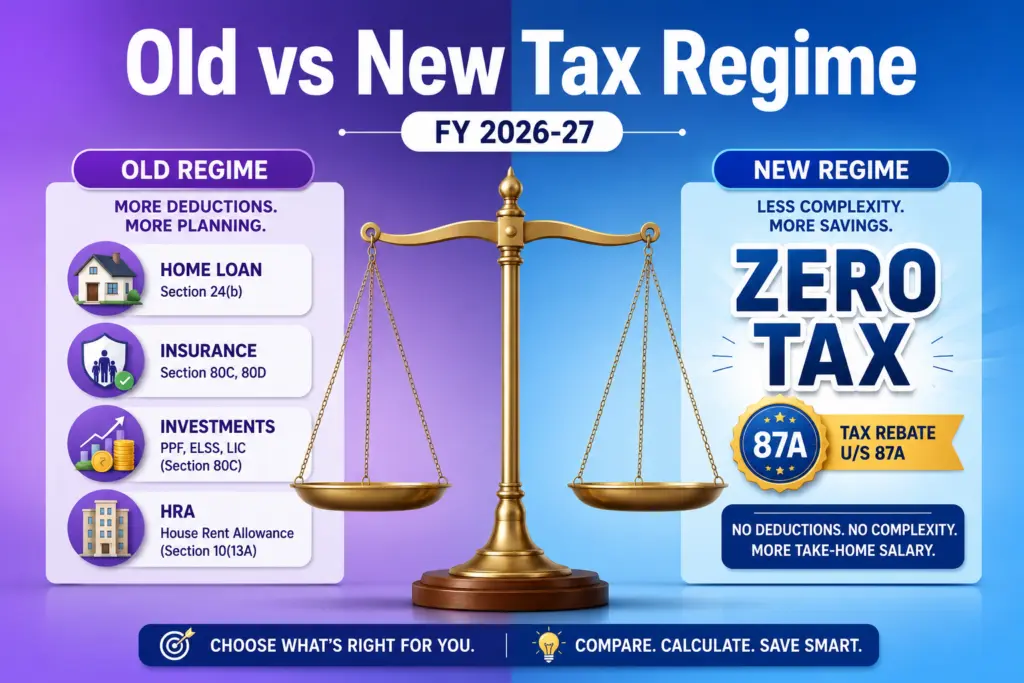
ITR season is here. And if you’re a salaried employee, there’s one question that’s probably bothering you: old regime ya new regime?
This is the most confusing tax decision most Indians make every year. And with AY 2026-27 being the last year under the Income Tax Act 1961, the stakes are even higher.
Let me break it down so you can decide in 5 minutes.
The Core Difference in One Paragraph
The new regime gives you lower tax rates but takes away almost all deductions and exemptions. The old regime has higher rates but lets you claim deductions like 80C, HRA, 80D, home loan interest, and more. Simple enough? Pick new if you don’t have many deductions. Pick old if you do.
Tax Slab Comparison
New Tax Regime (Default) — FY 2025-26 / AY 2026-27:
| Income Slab | Tax Rate |
|---|---|
| Up to Rs 4,00,000 | Nil |
| Rs 4,00,001 – Rs 8,00,000 | 5% |
| Rs 8,00,001 – Rs 12,00,000 | 10% |
| Rs 12,00,001 – Rs 16,00,000 | 15% |
| Rs 16,00,001 – Rs 20,00,000 | 20% |
| Rs 20,00,001 – Rs 24,00,000 | 25% |
| Above Rs 24,00,000 | 30% |
Old Tax Regime — FY 2025-26 / AY 2026-27 (Below 60 years):
| Income Slab | Tax Rate |
|---|---|
| Up to Rs 2,50,000 | Nil |
| Rs 2,50,001 – Rs 5,00,000 | 5% |
| Rs 5,00,001 – Rs 10,00,000 | 20% |
| Above Rs 10,00,000 | 30% |
Tax Calculation at 5 Income Levels
Let’s see actual numbers. I’m assuming a salaried person under 60, and for the old regime, claiming Rs 2 lakh in deductions (Rs 1.5L under 80C + Rs 50,000 standard deduction).
Don’t stress about memorizing the slabs. Just find your income in the table below and see what you’d actually pay.
New Regime:
| Gross Income | Std Ded | Taxable Income | Total Tax (After Rebate + Cess) |
|---|---|---|---|
| Rs 6,00,000 | Rs 75,000 | Rs 5,25,000 | Rs 0 |
| Rs 9,00,000 | Rs 75,000 | Rs 8,25,000 | Rs 0 |
| Rs 12,00,000 | Rs 75,000 | Rs 11,25,000 | Rs 0 |
| Rs 15,00,000 | Rs 75,000 | Rs 14,25,000 | Rs 97,500 |
| Rs 20,00,000 | Rs 75,000 | Rs 19,25,000 | Rs 2,01,500 |
Old Regime (with Rs 2L deductions):
| Gross Income | Deductions | Taxable Income | Total Tax (After Rebate + Cess) |
|---|---|---|---|
| Rs 6,00,000 | Rs 2,00,000 | Rs 4,00,000 | Rs 0 |
| Rs 9,00,000 | Rs 2,00,000 | Rs 7,00,000 | Rs 54,600 |
| Rs 12,00,000 | Rs 2,00,000 | Rs 10,00,000 | Rs 1,17,000 |
| Rs 15,00,000 | Rs 2,00,000 | Rs 13,00,000 | Rs 2,10,600 |
| Rs 20,00,000 | Rs 2,00,000 | Rs 18,00,000 | Rs 3,66,600 |
Who Wins at Each Income Level?
Rs 6 lakh income: Tie — both regimes give zero tax.
Rs 9 lakh income: New regime wins handsomely. You pay Rs 0 vs Rs 54,600. However, if you have HRA in a metro city plus heavy deductions, the gap narrows.
Rs 12 lakh income: New regime wins clearly. Rs 0 vs Rs 1,17,000. The 87A rebate makes the difference here.
Rs 15 lakh income: New regime wins. Rs 97,500 vs Rs 2,10,600. You save about Rs 1,13,100.
Rs 20 lakh income: New regime wins. Rs 2,01,500 vs Rs 3,66,600. You save about Rs 1,65,100.
But here’s the catch — if you have big deductions (HRA in metro city, home loan interest, 80D for parents, education loan interest), the old regime can still be better at higher incomes. If your total deductions cross Rs 3-4 lakh per year, run the numbers for your specific case.
The 87A Rebate — Why Rs 12.75 Lakh is Effectively Zero Tax
Under the new regime, Section 87A gives you a full tax rebate if your taxable income is up to Rs 12 lakh. For salaried employees with the Rs 75,000 standard deduction, this means:
If your gross salary is up to Rs 12.75 lakh, your tax is ZERO.
This is probably the single biggest tax benefit for the middle class right now. No deductions needed. No investments required. Just file your return and pay nothing.
Under the old regime, the rebate limit is only Rs 5 lakh taxable income (effectively Rs 5.5 lakh for salaried).
Deductions Comparison — What You Lose in the New Regime
| Deduction / Exemption | Old Regime | New Regime |
|---|---|---|
| Section 80C (PPF, ELSS, LIC, NSC) | Up to Rs 1,50,000 | Not available |
| Section 80D (Health Insurance) | Up to Rs 25K + Rs 50K for parents | Not available |
| HRA Exemption | Available | Not available |
| LTA Exemption | Available | Not available |
| Home Loan Interest (Section 24b) | Up to Rs 2,00,000 | Not available |
| Education Loan Interest (80E) | Unlimited | Not available |
| Standard Deduction | Rs 50,000 | Rs 75,000 |
| NPS Employer (80CCH) | Not available | Available |
One More Thing — This Year is a Milestone
AY 2026-27 is the last assessment year under the Income Tax Act, 1961. Starting from April 2026, the new Income Tax Act 2025 takes over. The slab rates haven’t changed for this year, but the framework is shifting.
What this means for you: nothing changes for this year’s filing. Just be aware that from next year, the tax return forms, section numbers, and some rules will look different.
Your Decision Framework
Ask yourself these questions:
- Do you claim HRA? If yes, old regime might work.
- Do you have a home loan? If yes, old regime could be better.
- Do you invest in PPF, ELSS, or LIC under 80C? If yes and totaling over Rs 1.5L, run the comparison.
- Do you pay health insurance premiums? If yes for yourself and parents, it adds up.
- Is your gross income below Rs 12.75 lakh? If yes, new regime = zero tax. No brainer.
Simple rule of thumb: If your total deductions are under Rs 3 lakh, pick the new regime. If they’re above Rs 4 lakh, the old regime likely wins. Between Rs 3-4 lakh, calculate both.
Action Steps
- Log in to the income tax portal (incometax.gov.in)
- Use the tax calculator to compare both regimes with YOUR actual numbers
- If you’re a business taxpayer and want the old regime, file Form 10-IEA before the ITR deadline
- For salaried employees, you can switch every year — no commitment needed
- Consult a CA if you have rental income, capital gains, or multiple income sources
Key Takeaway
The new regime is the default and works better for most salaried people — especially if your income is under Rs 12.75 lakh. But if you have significant deductions, don’t blindly pick new. Spend 10 minutes comparing both. That 10 minutes could save you over a lakh in taxes.
Disclaimer: This article is for educational purposes only. Tax laws are subject to change. Please consult a qualified Chartered Accountant for personalized tax advice.