You open your banking app, scan a QR code at the tea stall, and the money is gone by evening. Most of us do this fifty times a month. What we rarely ask is which account should be doing all that work — the one that pays us a little interest, or the one that gives cashback on every swipe. Kotak 811 and Jupiter are the two names almost everyone in India compares today. Here is the honest comparison, using the banks’ own published numbers.
The short version: both accounts pay 2.50% interest, so the rate is not the decision. Kotak 811 is the cheaper, simpler account with no minimum balance and no annual fee. Jupiter costs more and asks for more of you, and pays it back in cashback and better spending tools. Pick Jupiter only if you spend most of your money on merchant UPI QR codes and actually redeem the rewards. Otherwise pick Kotak 811 and stop thinking about it.
First, What Is a “Daily UPI Account”?
A daily UPI account is your spending account. It is where your salary lands, where the rent goes out, where you scan the vegetable vendor’s QR. It is not your savings account, and that distinction matters more than people think.
If you keep six months of expenses sitting in the same account you scan UPI from, then every UPI payment is quietly eating your safety net. One wrong transfer, one fraud attempt, one rent increase, and the buffer is gone.
Here is the setup we recommend in our bank account selection guide: one account holds the buffer and earns interest, and one separate account handles daily UPI. If the daily account is compromised, your savings are still sitting somewhere else.
That is what both Kotak 811 and Jupiter are competing for. Here is the first surprise — on interest, they are identical.
One quick thing before we start, because you will have seen it: some pages, including one on Jupiter’s own site, still advertise 3% interest. That page is stale. Jupiter’s current fee schedule says 2.50%, same as Kotak. We come back to this below.
Kotak 811: 2.50% With No Strings Attached
Kotak 811 is a savings account from Kotak Mahindra Bank. The number that matters is the interest rate, and Kotak’s own interest rate page is unambiguous: 2.50% per annum on all savings account balances, effective 9 July 2025. Not a slab rate. Not “up to” 2.5%. The same 2.5% whether you hold ₹5,000 or ₹5 lakh.
Two details about how that 2.5% is paid out are worth knowing. First, interest is credited quarterly — on 30 June, 30 September, 31 December and 31 March — not monthly. Second, Kotak calls it a floating rate, so it can move up or down. It has been 2.50% since July 2025; there is no promise it stays there.
What You Get on Kotak 811
- Zero minimum balance. No monthly balance requirement, and no charge if you fall below one.
- No program fee. The plain 811 account carries no annual fee.
- Free virtual debit card. First issuance is free; a replacement costs ₹49 each time.
- Free transfers. NEFT, IMPS and RTGS through the app and net banking carry no charge.
- Scan and Pay in the app for merchant QR codes.
- ActivMoney auto-sweep — available on full-KYC accounts. Set a threshold and balances above it are swept into a term deposit automatically, so idle money earns more than 2.50% without you doing anything.
- Credit card base. The 811 account is the base for the Kotak811 Dream Different Credit Card, which Kotak markets as a lifetime-free card.
The Catch: KYC Limits Before Full Verification
You can open 811 from home with Aadhaar and PAN, without a branch visit. But an account opened this way is not fully verified, and it comes with hard limits. Kotak’s General Schedule of Features and Charges, effective 1 April 2026, sets them out:
| Account type | Total credits allowed | Max balance at any time | Interest |
|---|---|---|---|
| Kotak 811 Limited KYC | ₹2,00,000 per year | ₹1,00,000 | Yes |
| Kotak 811 Lite Wallet | ₹5,000 per calendar month; ₹1,20,000 per financial year | ₹5,000 | No |
| Kotak 811 Full KYC | No restriction | No restriction | Yes |
You have 12 months to finish full KYC. After that the account gets restricted. So the ₹1 lakh cap above is not a permanent limit — it is a limit on how long you can leave your KYC half-finished.
One Important Clarification: 811 vs 811 Super
Search results and a lot of social media content conflate two different products. Do not mix them up.
Kotak 811 is the plain account: zero balance, 2.50% interest, no annual fee.
Kotak 811 Super is a different, paid variant. Kotak’s GSFC lists a program fee of ₹499 per year, inclusive of taxes. In return you get 5% cashback up to ₹500 per month (up to ₹6,000 a year) on eligible debit card spends, a free Platinum debit card, and a free chequebook. Its average monthly balance requirement is zero.
You will also see claims online that 811 Super pays a higher interest rate — 3.5% or 4.0% — than the plain account. Kotak’s official interest rate page lists a single savings rate of 2.50% across all account balances, with no carve-out for any variant, and the 811 Super page sells cashback and card benefits rather than a better rate. We found no bank source for a higher Super rate, so we are not claiming one.
Is the ₹499 Worth It?
It depends entirely on how you spend. 811 Super’s cashback applies to eligible debit card spends, and card-not-present and online transactions are frequently excluded from schemes like this. If your spending is mostly UPI QR, you may collect very little of it. Run one full month of your statements against the terms before you pay.
Jupiter: Great App, Real Fees, and an Interest Rate Surprise
Jupiter is built by Amica Financial Technologies, and it is not a bank — the company says so itself. Your account is opened with a regulated partner bank, and that bank holds your money.
Which bank issued yours decides where your insurance sits. Federal Bank issues Jupiter savings accounts, and Federal Bank’s own Jupiter terms govern those accounts. Jupiter’s regulatory footer also lists CSB Bank among partner banks that may issue accounts from time to time. Check which bank issued yours.
Jupiter’s savings rate is 2.50% up to and including ₹1 lakh — the same as Kotak 811, not higher. The next step up on Jupiter’s published slab table, 4.00%, applies between ₹10 crore and ₹50 crore. That is institutional money.
So: on interest, the two accounts are a tie. If you chose Jupiter expecting 3%, that expectation comes from an outdated comparison page, not from the current schedule.
Two Numbers You Will See Online Are Wrong
Jupiter’s fee, rates and charges page, last updated 5 September 2026, is the schedule of record. It says a flat 2.50% on savings balances up to ₹1 lakh.
The same website’s savings-versus-salary comparison page still says “starting from 3%” interest, a debit card at ₹199 excluding GST, and a non-maintenance fee of “up to ₹200”. All three contradict the fee page on the same site.
If a number is going to change which account you open, check it against the bank’s fee schedule before you act, not against a comparison page.
Jupiter’s Real Advantage: Rewards and Organisation
What Jupiter genuinely does better is the software around the account.
- Jewels rewards. Jupiter pays Jewels back on merchant UPI spends — Jupiter’s FAQ describes a flat 1% on most merchant transactions. The redemption value varies by route: 100 Jewels is ₹20 on flights and miles, ₹14 on vouchers, digital gold, insurance and the EMI Store. Redeem on the flight route if you can.
- Pots. Digital piggy banks inside your account. Money in a Pot still earns interest, but you can spend straight from it, which keeps micro-transactions out of your main statement.
- Spend Insights. Every outgoing payment is auto-categorised — Dining, Travel, Shopping, Bills — with a wellness score and tips.
- No-Penalty SIP. If your balance is too low to cover a scheduled mutual fund SIP, Jupiter pauses it instead of charging you a penalty.
- Linked accounts. Pull in your other bank accounts to see one consolidated balance.
- Protection products. Fraud Protect, Screen Protect, Salary Protect and UPI Protect, all bought in-app.
One caveat on that 1%. Jupiter’s homepage carousel advertises “up to 5% Jewels” while its own FAQ says flat 1%. We are going with the lower, specific number.
Jupiter’s Real Cost: It Is Not Free
This is where the marketing and the fee schedule part ways. Jupiter publishes three account tiers, and only one has no minimum balance:
| Tier | Minimum average monthly balance | What you get |
|---|---|---|
| Basic | ₹5,000, held across savings and Pots | First 3 IMPS transactions a month; 3 free non-Federal ATM withdrawals a month in metro regions, 5 in non-metro regions |
| PRO | ₹10,000 in savings/Pots, or ₹40,000 in an FD or SuperPot | No IMPS charge; forex-free up to ₹25,000 a month; higher rewards |
| Salary | Zero balance, with salary credited | No IMPS charge; forex-free up to ₹1,00,000 a month; debit card fee waiver available |
Fall below your tier’s minimum and you can be charged up to ₹353 including taxes in the first assessed month, and the charge comes back every month you stay short. The slab rates run from ₹60 to ₹300 before tax.
There is a way out, and it is worth knowing. You escape the ₹5,000 minimum balance requirement either by holding ₹5,000 as an average across your savings account and Pots, or by creating a Fixed Deposit or SuperPot of ₹20,000 or more. If you park ₹20,000 in an FD, you have no minimum-balance liability at all. Most comparisons skip this, and it changes the picture for anyone who keeps a few months’ expenses parked.
The other charges, from Jupiter’s published schedule:
- Physical debit card: ₹350 + GST on issuance, then ₹299 + GST a year from the second year on. Waived if you hit ₹25,000 in eligible merchant spends over 12 months, or hold PRO or Salary status for 6 of those 12 months.
- IMPS: free on PRO and Salary. Basic and Verified accounts get the first 3 transactions free each month, then it is charged slab-wise from ₹2.50 per transaction.
- UPI, NEFT and RTGS online: no charges.
- Forex: 3.5% on all international spends for savings account holders, plus a 1% dynamic currency conversion charge if you let the transaction settle in rupees. PRO gets up to ₹25,000 a month forex-free; Salary gets up to ₹1,00,000 a month. Outside-India ATM withdrawals cost ₹200 plus 3.5% forex.
- Account closure: free within 14 days of opening, ₹353 after that.
Head-to-Head: Kotak 811 vs Jupiter
Both accounts pay 2.50% interest, so that is not where the choice is decided. Kotak 811 has no minimum balance and no annual fee. Jupiter charges a debit card fee from the second year, and asks for the Salary tier or ₹5,000 to ₹10,000 parked before you get zero balance. The table below is the evidence for that.
| Point of comparison | Kotak 811 | Jupiter |
|---|---|---|
| Who issues the account | Kotak Mahindra Bank | A regulated partner bank. Federal Bank issues Jupiter savings accounts and names them in its Jupiter T&C; Jupiter also lists CSB Bank among partner banks that may issue accounts from time to time. Jupiter is a technology partner, not a bank. |
| Interest rate | 2.50% p.a. on all balances, w.e.f. 9 July 2025 | 2.50% p.a. up to ₹1 lakh. The 4% slab starts at ₹10 crore. |
| Interest payout | Quarterly — 30 Jun, 30 Sep, 31 Dec, 31 Mar | Not published on the fee page |
| Zero balance | Yes. No minimum balance, no non-maintenance charge. | Yes on the Salary tier only. Basic needs ₹5,000, PRO needs ₹10,000 (or ₹40,000 in an FD/SuperPot). Low-balance charge up to ₹353 incl. taxes per month. A ₹20,000 FD or SuperPot releases you from the requirement. |
| Annual account fee | None on the plain 811 account | No account-opening fee, but a ₹299 + GST debit card annual fee from year 2, plus IMPS charges on the Basic tier |
| Pre-full-KYC limits | ₹1 lakh balance and ₹2 lakh credits a year (Limited KYC). 12 months to complete full KYC. | Not published |
| UPI and transfers | UPI, NEFT, IMPS, RTGS free through app and net banking | UPI, NEFT, RTGS free. IMPS free only on PRO and Salary; 3 free transactions a month on Basic. |
| Rewards | No UPI cashback on the plain account. 811 Super (₹499/yr) offers 5% cashback up to ₹500/month on eligible debit card spends. | Jewels on merchant UPI spends — Jupiter’s FAQ says flat 1% back, its homepage says “up to 5%”. Redemption value varies by route: ₹20 per 100 Jewels on flights and miles, ₹14 on vouchers and digital gold. |
| Automatic saving | ActivMoney sweep into a term deposit (full-KYC accounts only) | Pots — spendable sub-accounts that still earn interest |
| Spend tracking | Standard transaction views and statements | Spend Insights with auto-categorisation and a wellness score |
| Debit card | Virtual card free on first issue, ₹49 per replacement. The default Dream Different physical card for a plain 811 account is ₹399 a year (₹399 issuance + ₹399 anniversary). 811 Super holders pay ₹299. Higher variants cost more — Platinum ₹799, Infinity Metal ₹3,999. | ₹350 + GST issuance; ₹299 + GST annual fee from year 2, waivable on ₹25,000 qualifying spend or 6 months on PRO/Salary |
| Forex | Separate forex card available at ₹250 issuance | 3.5% on international savings-account spends, plus 1% DCC; monthly forex-free allowance on PRO and Salary |
| DICGC deposit insurance | ₹5 lakh per depositor per bank, with Kotak Mahindra Bank | ₹5 lakh per depositor per bank, with the partner bank that issues the account. If one bank’s balance is approaching that limit, see our guide to spreading an emergency fund safely across banks. |
| Best for | Someone who wants one simple account with no fees, no reward chasing and a genuine 2.50% | Someone who spends most of their money on merchant UPI and will actually use Pots and Spend Insights |
Who Should Pick Which
Pick Kotak 811 if you are a student, a first-jobber or a freelancer who wants an account that behaves predictably. No tier to choose. No balance to maintain. No rewards maths at the end of the month. You want 2.50% and you want to stop thinking about it. Kotak 811 also suits you if you need a chequebook or a physical debit card later, because full-KYC 811 accounts support both — Jupiter’s fee page does not list a chequebook facility at all.
Pick Jupiter if you run almost all your spending through merchant UPI QR codes and you will actually redeem the rewards. But do the arithmetic before you decide. On ₹40,000 of merchant UPI spends a year, roughly 1% back is about ₹400. Set that against 2.50% interest on the same money: interest wins comfortably, because 2.5% of ₹40,000 is ₹1,000 a year. The break-even is a balance of about ₹16,000. Below that, Jupiter’s rewards are worth more than the interest you give up. Above it, plain interest wins.
So the honest version: Jupiter’s rewards beat 2.50% interest only if you keep a small balance and spend heavily through UPI. And that calculation assumes you redeem on the ₹20-per-100-Jewels route — on vouchers and digital gold you get ₹14, and the advantage shrinks further.
Jupiter is also the better pick if you like seeing your spending sorted into categories automatically, and if the Salary tier’s zero-balance requirement is no problem because your salary lands there anyway.
Pick neither yet if you are comparing only on interest rate. They are the same. 2.50% versus 2.50%. Any article that tells you one pays meaningfully more than the other on a retail balance is making it up.
Whichever you pick, this is only the first account. Once you have decided that 2.50% is enough for your daily spending, the second account is where the money should earn more — our guide to the best savings bank accounts in India covers that choice.
For the full four-account setup — daily spending, emergency fund, tax savings, long-term investments — read the full Best Banking Accounts in India guide. This page covers only account number one.
How to Open Either One
Both accounts are fully digital. You do not visit a branch.
For Kotak 811: download the Kotak Mobile Banking App or go to the bank’s website, register with your PAN, Aadhaar number and basic details, set a mobile banking PIN, and start using the account. Full KYC needs a video-based customer identification process (V-CIP). If you do not have an Aadhaar number, you can still open an 811 Lite account with your PAN — but that tier earns no interest and caps your balance at ₹5,000.
For Jupiter: download the Jupiter app and complete the digital onboarding. Jupiter’s site claims it takes just under three minutes. You will need your Aadhaar e-KYC details pulled from UIDAI, your PAN, a cancelled cheque or bank statement, and a selfie. Check which bank issued your account in the app — that determines who holds your deposit.
On both, complete full KYC early. On Kotak 811 you have twelve months, and there is a ₹1 lakh balance ceiling until you do.
Risks to Know About
- Interest rates are floating. Both 2.50% rates can change. Kotak’s page explicitly says rates are subject to change. Do not build a fixed plan around today’s number.
- Reward schemes change, and Jupiter’s own pages disagree. The homepage advertises “up to 5% Jewels” while the FAQ says “flat 1% back”. Redemption value differs by route. Check current terms before planning around the rewards.
- Both are savings accounts, not investment accounts. 2.50% will not beat inflation over a long stretch. This account is for money you need within a few years.
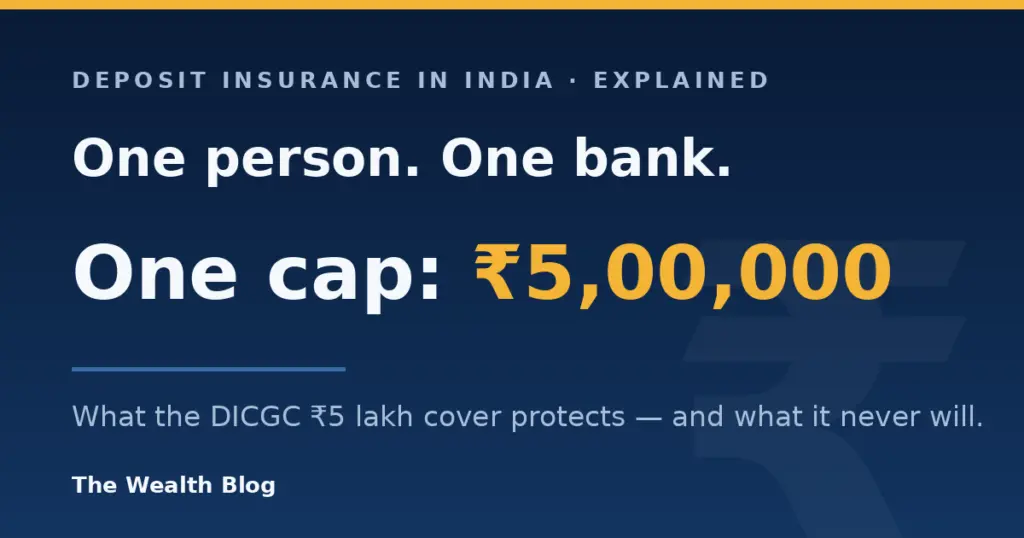
- DICGC cover is capped at ₹5 lakh per depositor per bank. Because the limit is per bank, holding an account at Kotak and one at Jupiter’s partner bank gives you two separate limits. That is a genuine advantage of running both.
- UPI fraud is real. Never approve a “collect request” you did not initiate. Both banks offer transaction-level protections, but the first defence is you not tapping the prompt.
- Jupiter is not a bank. Your deposit sits with a partner bank. If you are uneasy with an intermediated structure, Kotak 811 — issued directly by Kotak Mahindra Bank — is the simpler proposition.
Key Takeaways
- Both accounts pay 2.50% interest. The rate is not the decision.
- Kotak 811 has no minimum balance and no annual fee. That is the whole pitch.
- Jupiter’s zero balance needs the Salary tier. Everyone else pays up to ₹353 a month if they fall short — unless they park ₹20,000 in an FD or SuperPot, which releases them from the requirement.
- Jupiter’s rewards beat the interest only below a balance of about ₹16,000.
- Your deposit insurance sits with the bank that issues the account, at ₹5 lakh per depositor per bank. Holding both gives you two separate limits.
Frequently Asked Questions
Is Kotak 811 better than Jupiter?
There is no single winner. Kotak 811 is simpler and cheaper: zero minimum balance, no account fee, free transfers, and it supports a chequebook. Jupiter pays roughly 1% back on merchant UPI spends and gives you better spending tools, but you need the Salary tier for zero balance and you should expect a debit card annual fee from year two. If your balance is small and your spending is mostly UPI QR payments, Jupiter’s rewards can outweigh its fees.
Which account pays more interest, Kotak 811 or Jupiter?
Neither, on a normal retail balance. Both pay 2.50% per annum. Kotak pays it across all balances and credits it quarterly. Jupiter pays 2.50% up to and including ₹1 lakh, which covers every individual account. The next rate step on Jupiter’s published table, 4%, applies only from ₹10 crore.
Do I need a minimum balance in a zero-balance UPI account?
For Kotak 811, no. There is no minimum balance and no penalty for falling below it. For Jupiter, it depends on the tier: Salary has zero balance, Basic needs ₹5,000 average monthly balance and PRO needs ₹10,000, with charges of up to ₹353 including taxes if you fall short. On Jupiter you can also avoid the requirement entirely by creating a Fixed Deposit or SuperPot of ₹20,000 or more.
Is my money safe in a Jupiter account?
Jupiter is not a bank. It says so itself. It is a technology platform whose partner bank holds your deposit. Federal Bank issues Jupiter savings accounts, and Jupiter also lists CSB Bank among partner banks that may issue accounts from time to time, so check which bank issued yours. Deposits are insured up to ₹5 lakh per depositor per bank under DICGC, the same cover you get at any scheduled commercial bank, and the limit applies separately at each bank.
Can I open Kotak 811 without Aadhaar?
You can, but only as an 811 Lite account using your PAN. That version earns no interest and caps your balance at ₹5,000 at any time, with ₹5,000 of total credits allowed per calendar month. Full KYC unlocks the real account.
Is 811 Super the same as Kotak 811?
No. Kotak 811 is free with no program fee. 811 Super carries a program fee of ₹499 per year inclusive of taxes and returns 5% cashback up to ₹500 per month on eligible debit card spends, plus a free Platinum debit card and chequebook. Both pay the same 2.50% interest.
Disclaimer: This article is for educational and informational purposes only and does not constitute financial advice, or a recommendation to open any specific account. Interest rates, fees, reward structures and minimum balance requirements are subject to change by the respective banks — always verify them on the bank’s official fee schedule before applying. Deposit insurance is subject to DICGC rules and limits of ₹5 lakh per depositor per bank. This page may contain affiliate links; we are not compensated for changing the conclusions above.
Sources
- Kotak Mahindra Bank — Interest Rates (savings 2.50% across all balances, effective 9 July 2025; quarterly payout on 30 Jun / 30 Sep / 31 Dec / 31 Mar)
- Kotak 811 — Zero Balance Digital Savings Account
- Kotak 811 — FAQ (account variants, KYC limits; contains a stale ₹199 debit card figure, superseded by the GSFC)
- Kotak Mahindra Bank — General Schedule of Features and Charges for 811 Savings Account, effective 1 April 2026 (811 Super ₹499/year program fee; debit card variant table ₹399–₹3,999; virtual card ₹49 per replacement; ATM charges)
- Jupiter — Fee, Rates and Charges (last updated 5 September 2026; interest slabs, debit card and forex charges, ATM free limits, IMPS slabs, closure charges; the ₹199 + GST card rate applies only to accounts opened before the 2023 cut-off dates)
- Jupiter — AMC/AMB/PRO FAQs (₹5,000 minimum balance; ₹20,000 FD or SuperPot alternative; ₹10,000 / ₹40,000 PRO criteria; AMB shortfall slabs; current ₹299 + GST debit card fee)
- Jupiter — Homepage and FAQ (Pots, Spend Insights, No-Penalty SIP, Jewels redemption rates, three account tiers, DICGC cover, regulatory footer on partner banks)
- Jupiter — Savings vs Salary comparison page (cited only as an example of an out-of-date page; its “starting from 3%”, ₹199 card and ₹200 non-maintenance fee figures are superseded by the fee schedule)
- The Federal Bank Ltd — Jupiter Terms and Conditions
- Deposit Insurance and Credit Guarantee Corporation (DICGC)
- Reserve Bank of India — Basic Savings Bank Deposit Accounts