Most Indians keep money in savings accounts earning 2.5 to 3.5 percent. With inflation at 5 to 6 percent, your purchasing power drops every year. But you can earn up to 6.75 percent on your savings, with the same DICGC protection SBI offers.
This guide covers the best savings accounts in India for 2026. We compared 11 banks across interest rates, fees, digital experience, and safety. By the end, you’ll know exactly which account fits your life — and one action to take today.
Verification note: All rates below were re-checked against official bank websites and RBI/rating-agency sources on 11 July 2026. Banks revise rates often — always confirm on the bank’s site before opening.
Quick Comparison Table
| Bank | Interest Rate (Slabs) | Best For | Min Balance | DICGC Cover | Affiliate Link |
|---|---|---|---|---|---|
| AU Small Finance Bank | 2.50% (less than 1L), 2.50% (1L–3L), 2.75% (3L–5L), 3.50% (5L–10L), 6.50% (10L–25Cr), 6.75% (above 25Cr) | Highest blended yield | Zero | Yes 5L | Open AU SFB Account |
| Equitas Small Finance Bank | 2.50% (≤3L), 5.00% (3L–5L), 6.00% (5L–10L), 6.50% (10L–25Cr), 7.00% (>25Cr) | 5-tier slab, 7% peak above ₹25Cr | Zero | Yes 5L | Open Equitas SFB Account |
| IDFC FIRST Bank | 2.50% (≤3L), 6.50% (3L–25Cr), 5.00% (>25Cr) | High yield 3L–25Cr + digital UX | Zero (select variants) | Yes 5L | Open IDFC FIRST Account |
| Kotak 811 | 3.50% (up to 50L, conditions apply), 4.00% (above 50L) | Zero-balance plus great app | Zero | Yes 5L | Open Kotak 811 Account |
| Unity Small Finance Bank | 4.50% (any balance), 6.00% (above 1L), 7.00% (above 25L)* | Rate only, see risks | Zero | Yes 5L | Open Unity SFB Account |
| ESAF Small Finance Bank | 2.50% (≤1L), 4.00% (1L–10L), 5.00% (10L–25L), 6.00% (25L–1Cr), 6.50% (1Cr–5Cr), 7.00% (5Cr–25Cr), 7.50% (25Cr–100Cr), 8.00% (>100Cr) | Maximum rate chasers | Zero | Yes 5L | Open ESAF SFB Account |
| Suryoday Small Finance Bank | 3.00% (≤1L), 4.00% (1L–10L), 5.00% (10L–25L), 6.00% (25L–1Cr), 7.00% (1Cr–5Cr), 7.60% (5Cr–25Cr) | High balance holders | Zero | Yes 5L | Open Suryoday SFB Account |
| SBI | 2.50% (flat, w.e.f. 15.06.2025) | Trust, branch network | Zero | Yes 5L | Open SBI Account |
| HDFC Bank | 2.50% (flat, w.e.f. 24.06.2025) | Ecosystem (cards, demat) | 5,000 to 25,000 | Yes 5L | Open HDFC Account |
| ICICI Bank | 2.50% (flat, w.e.f. 26.06.2025) | Digital services (iMobile) | 10,000 to 1.25L | Yes 5L | Open ICICI Account |
| Axis Bank | 2.50% (flat, w.e.f. 12.06.2025) | Auto-sweep (Auto-FD) | 10,000 to 25,000 | Yes 5L | Open Axis Account |
Unity SFB: Source verified 11 Jul 2026 — 4.50% any balance, 6.00% above ₹1 lakh, 7.00% above ₹25 lakh. ICRA rates Unity A- (Stable) on asset-quality stress; park only ≤5L here.
Rate check: All rates above are from official bank websites as of 11 July 2026. The big four private/PSB banks (SBI, HDFC, ICICI, Axis) now pay a flat 2.50% after mid-2025 revisions.
Best for Highest Interest Rate: AU Small Finance Bank
Why: Up to 6.75 percent on balances above 25 crore — among the highest accessible savings yields in India. Monthly interest credit means faster compounding. No minimum balance penalty on regular savings.
Real example: A 25 lakh balance at AU SFB’s 6.50% tier (10L–25Cr) earns about 1,62,500 rupees a year. The same 25 lakh in SBI at 2.50% earns 62,500 rupees. That is 1,00,000 extra rupees, for the same DICGC safety.
Trade-off: Fewer branches (digital-first). AAA-rated, strong but below PSU banks’ quasi-sovereign backing.
Pro tip: If your balance stays under 5 lakh, AU SFB gives you a high return with full DICGC cover.
Higher rate but newer name? We stress-tested that question separately: here’s whether small finance banks are safe for your emergency fund, and how to spread it across banks fully insured.
Best for Trust and Branch Access: SBI
Why: Government-owned, more than 22,000 branches, zero minimum balance since 2016.
Reality check: At 2.50 percent (revised June 2025), you lose about 1,00,000 rupees per year on 25 lakh versus AU SFB. But if you need a branch within 2 km, or your salary account is here, stay — convenience has value.
Best for Tech-Savvy and Zero Balance: Kotak 811
Why: 3.5 percent up to 50 lakh (conditions apply), 4 percent beyond. Full video KYC in 5 minutes. App rated 4.6+ on Play Store. No minimum balance ever.
Hidden gem: ActivMoney auto-sweep moves surplus above 25,000 rupees automatically into an FD earning about 7.2 percent. No lock-in. Withdraw anytime. Your effective blended yield jumps to 6 to 7 percent.
Affiliate placement: Open Kotak 811 plus ActivMoney to get the zero-balance account and the auto-sweep feature in one flow.
Best for High Yield plus Digital UX (Balances Above 3 Lakh): IDFC FIRST Bank
Why: 6.50 percent on balances from 3 lakh to 25 crore (2.50% below 3 lakh, 5.00% above 25 crore). Monthly interest credit. Free unlimited ATM withdrawals at any bank. Visa debit card for life with no annual fee on select variants.
Best variant: Zero Balance Savings Account, no MAB, same rates. Great for parking your emergency fund while earning real returns.
Highest Rate (With Caveat): Unity Small Finance Bank
Rate: 4.50% on any balance, 6% above 1 lakh, 7% above 25 lakh. Looks unbeatable on paper.
Why I hesitate: GNPA of 5.82 percent (ICRA, 31 Mar 2026) versus 0.5 percent for SBI. Internal fraud exposure of ₹70 crore (Times of India, 6 Mar 2026). ICRA downgraded the bank to A- (Stable) citing asset-quality stress. Provision Coverage Ratio is 94% (with technical write-offs), and promoters must infuse ₹900 crore by October 2026. DICGC covers 5 lakh, but the hassle of a bank resolution is not worth the extra yield for most people.
Use only if: Balance is 5 lakh or less, you are comfortable with digital-only, and you accept higher governance risk.
1. DICGC Coverage, The Safety Net You Did Not Know You Had
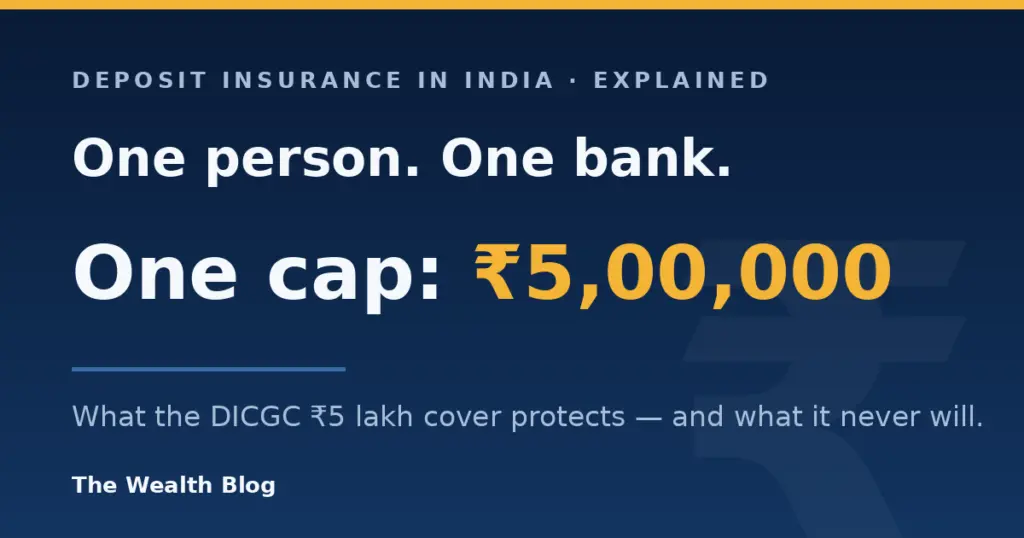
Every RBI-licensed bank, including all SFBs above, is covered by DICGC up to 5 lakh rupees per depositor, per bank.
Key Point: Coverage is per depositor, per bank (not per account). If you open multiple accounts at the same bank, total protection is still only 5 lakh.
- SBI fails? You get 5 lakh.
- AU SFB fails? You get 5 lakh.
- Both fail same day? You get 5 lakh from each.
Strategy for more than 5 lakh: Split across banks. 5L in AU SFB plus 5L in Equitas equals 10L fully insured. For the rest, move to FDs or G-Secs.
Read the DICGC official guide: DICGC Deposit Insurance
Want the fine print beyond the basics — the one-cap pooling rule, the interest trap, and how payouts actually arrive? See our explainer on how the Rs 5 lakh deposit insurance cover works.
2. Tax Treatment — Keep More of Your Interest
| Section | Who | Deduction Limit | Regime |
|---|---|---|---|
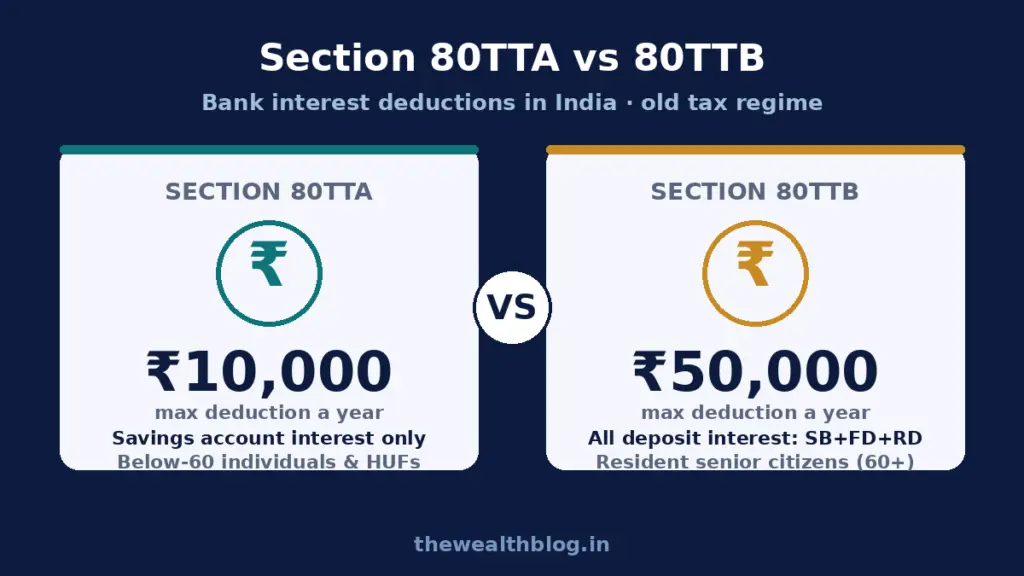
| 80TTA | Individuals and HUF (non-senior) | 10,000 per year | OLD regime only |
| 80TTB | Senior citizens (60+ years) | 50,000 per year | OLD regime only |
Important: Both 80TTA and 80TTB are available ONLY under the old tax regime. The new tax regime (Section 115BAC) does NOT allow these deductions. From Tax Year 2026-27, 80TTA/80TTB are consolidated into Section 153 of the new Income Tax Act 2025 — with the same ₹10,000 / ₹50,000 limits.
Key facts:
- TDS is not deducted on savings account interest, unlike FDs.
- FD interest TDS threshold: ₹40,000 for general taxpayers; ₹1,00,000 for senior citizens (raised from ₹50,000 by Budget 2025).
- You must report interest under Income from Other Sources in your ITR.
- Claim deduction during filing, not at source.
- New tax regime? No deduction available, so factor this in.
New to these sections? The full guide to Section 80TTA vs 80TTB covers eligibility, ITR claim steps, and TDS rules in detail.
Only getting started? Our roundup of the best bank accounts in India for every need explains how savings, current and zero-balance accounts differ.
Example: You earn 40,000 rupees savings interest. Old regime plus 80TTA gives a 10,000 deduction. Taxable amount is 30,000. Senior citizen? 80TTB covers all 40,000.
3. Auto-Sweep Strategies — Earn FD Rates with Savings Flexibility
| Bank | Feature | Threshold | FD Rate (approx) | Lock-in |
|---|---|---|---|---|
| Kotak | ActivMoney | 25,000 | about 7.2 percent | None |
| Axis | Auto-FD | 25,000 | about 7.0 percent | None |
| IDFC FIRST | Sweep Facility | Varies | about 7.0 percent | None |
How it works: Keep 25,000 rupees in savings earning 3.5 to 6 percent. Every rupee above that auto-moves to an FD. Need money? It sweeps back instantly. No penalty. No forms.
Blended yield example (Kotak 811 plus ActivMoney, 2 lakh balance):
- 25,000 at 3.5 percent = 875 rupees
- 1,75,000 at 7.2 percent = 12,600 rupees
- Total: 13,475 rupees (6.74 percent blended) versus 7,000 rupees at 3.5 percent plain
Action: If you maintain more than 50,000 rupees average balance, enable auto-sweep today. It is free money.
4. Decision Framework — Pick Your Account in 2 Minutes
| Your Situation | Primary Pick | Backup Pick |
|---|---|---|
| Balance 5L or less, want max return, digital OK | AU SFB (3.50% tier if 5L–10L) | Equitas SFB (5% tier if 3L–5L) |
| Balance 5L or less, need zero balance plus great app | Kotak 811 | IDFC FIRST Zero Balance |
| Balance 3L to 25Cr, want high yield plus safety | IDFC FIRST (6.50%) | AU SFB (6.50%) |
| Balance above 25Cr, max yield | Equitas (7.00%) | AU SFB (6.75%) |
| Need branches, trust, salary account | SBI | HDFC or ICICI |
| Senior citizen, simple, tax-efficient | SBI plus 80TTB | Any high-yield plus 80TTB |
| Tech-first, want ecosystem (cards, demat) | HDFC or ICICI | Kotak 811 |
Risks and Caveats (Read Before You Switch)
- Rate changes: The big banks cut savings rates to 2.50% in mid-2025. SFBs revise slabs quarterly. Set a calendar reminder to check every 3 months.
- DICGC limit: 5 lakh per bank. Do not park 20 lakh in one SFB.
- Governance risk: Unity SFB issues show SFBs are not risk-free. Stick to AU, Equitas, and IDFC FIRST for large balances.
- Minimum Average Balance (MAB): SBI is zero. HDFC, ICICI, Axis range from 5,000 to 1.25 lakh. Kotak 811 is zero but has a 499 rupee per year program fee for the Edge variant. “Zero-balance” terms change frequently — verify at onboarding.
- Digital KYC fails: If video KYC rejects you due to name mismatch or poor lighting, you need a branch visit, defeating the purpose.
- Tax regime trap: New regime means no 80TTA or 80TTB. High earners often lose by switching. Calculate both.
Action Steps — Do This Today
- Check your current rate. Log into your bank app. Note the savings interest rate (if it is a big bank, it is likely 2.50% now).
- Calculate the gap. If you have 5 lakh at 2.50 percent (SBI), you earn 12,500 per year. At 6.50 percent (IDFC FIRST, above 3L), you would earn 32,500. Gap is 20,000 rupees.
- Pick one account from the decision framework above.
- Open digitally. Video KYC takes 10 minutes. Use the affiliate links above. No extra cost to you, and it supports this blog.
- Enable auto-sweep if balance is above 50,000 (Kotak ActivMoney or Axis Auto-FD).
- Set a quarterly calendar alert to check savings rate and DICGC allocation.
- File ITR under the old regime if savings interest is above 10,000 (or 50,000 for seniors) and claim 80TTA or 80TTB (Section 153 from TY 2026-27).
Key Takeaway
The difference between 2.50 percent (SBI) and 6.50 percent (IDFC FIRST, above 3 lakh) on 5 lakh is 20,000 rupees per year. Over 10 years, that is 2 lakh rupees, for the same DICGC safety.
Pick one account from the table. Open it this week. Enable auto-sweep. Done.
FAQ
Q: Which bank gives highest interest on savings account in 2026? A: ESAF SFB offers up to 8.00% on balances above ₹100 crore, and Suryoday up to 7.60% (₹5Cr–25Cr). For most readers (balances under ₹25 crore), AU SFB (6.75% above ₹25 crore) and Equitas (7.00% above ₹25 crore) lead. Note: 7.25% quoted for AU SFB is the FD rate, not savings.
Q: Is money safe in Small Finance Banks? A: Yes. All Small Finance Banks are RBI-licensed and DICGC-insured up to 5 lakh per depositor, same as SBI, HDFC, and ICICI.
Q: Can I have multiple savings accounts? A: Yes. No limit. Smart strategy: Split 10 lakh across 2 SFBs (5L each) for full DICGC cover plus high yield.
Q: What is auto-sweep and should I use it? A: Auto-sweep moves surplus above a threshold (for example 25,000) into an FD earning ~7%, with instant withdrawal and no penalty. Recommended if you maintain 50,000+ average balance.
Q: Which tax regime should I choose for savings account interest? A: Under the old tax regime, claim ₹10,000 deduction under Section 80TTA (or ₹50,000 under 80TTB if you are 60+). The new regime allows no such deduction. From TY 2026-27 these move to Section 153 of the Income Tax Act 2025 (same limits).
Q: Are zero-balance savings accounts truly zero balance? A: Kotak 811, IDFC FIRST Zero Balance, and AU SFB Regular Savings have no Minimum Average Balance (MAB) requirement. HDFC, ICICI, and Axis zero-balance variants often have hidden conditions. Terms change, so verify at onboarding.
Q: How often do savings account interest rates change in India? A: The large banks last cut savings rates to 2.50% in June 2025. SFBs typically revise slabs quarterly — in March, June, September, and December. Set a quarterly reminder to check the bank’s official website.
Q: What is the DICGC insurance limit per bank? A: DICGC insures deposits up to Rs 5 lakh per depositor, per bank. If you hold accounts in multiple banks, each bank’s deposits are insured separately up to Rs 5 lakh.
Disclosure: This article contains affiliate links. We may earn a commission if you open an account, at no extra cost to you. We only recommend products we’ve researched and believe serve readers first.
Last verified: 11 July 2026. Rates change often — always cross-check on the bank’s official website before opening.