

Investment
Rules of Compounding: 72, 114, 144 and 70 Explained
The rules of compounding explained: 72 for doubling, 114 for tripling, 144 for quadrupling, and 70 for how inflation halves idle cash — with examples.

In this guide
- Rule of 72 — time to double
- Rule of 114 — time to triple
- Rule of 144 — time to quadruple
- Rule of 70 — inflation's tax on idle money
- The four rules in one table
- Where these rules meet your actual investments
- The mistakes that break compounding
- How accurate is the rule of 72?
- The ladder at 7%, 9% and 12%
- The cost of waiting, priced
- What a 1% fee does to the curve
- Compounding in reverse: expensive debt
- Putting the rules to work this week
- Conclusion
Compound interest is the quietest force in personal finance: your returns start earning their own returns, and the curve steepens every year. The only friction is the math — which is why a set of mental shortcuts, the rules of compounding, exists. Four divisions of two numbers tell you how fast your money doubles, triples or quadruples, and how fast idle money halves.
The famous quote is often attributed to Albert Einstein: compound interest is the eighth wonder of the world — he who understands it earns it, he who doesn't pays it. Attribution is shaky; the insight is not. Here are the four rules, each with a worked example.
Key takeaways
- Rule of 72: divide 72 by your annual return to get years to double — at 6% that is 12 years, at 9% just 8.
- Rule of 114 gives years to triple (19 years at 6%); rule of 144 gives years to quadruple (24 years at 6%).
- Rule of 70: at 7% inflation, idle money loses half its purchasing power in 10 years.
- At 12% returns the same ₹1,00,000 quadruples in 12 years instead of 24 — the gap between 6% and 12% compounds into 4x.
- India's long-run CPI inflation averages around 5-6%, so any long-term instrument must clear roughly 6% just to hold real value.
- PPF's 7.1% rate continues through the October-December 2026 quarter — doubling in roughly 10 years.
- Early withdrawals and interrupted SIPs reset compounding exactly when the curve gets steep — the costliest mistakes.
Rule of 72 — time to double
!Explainer sketch of the rule of 72 doubling money — The Wealth Blog
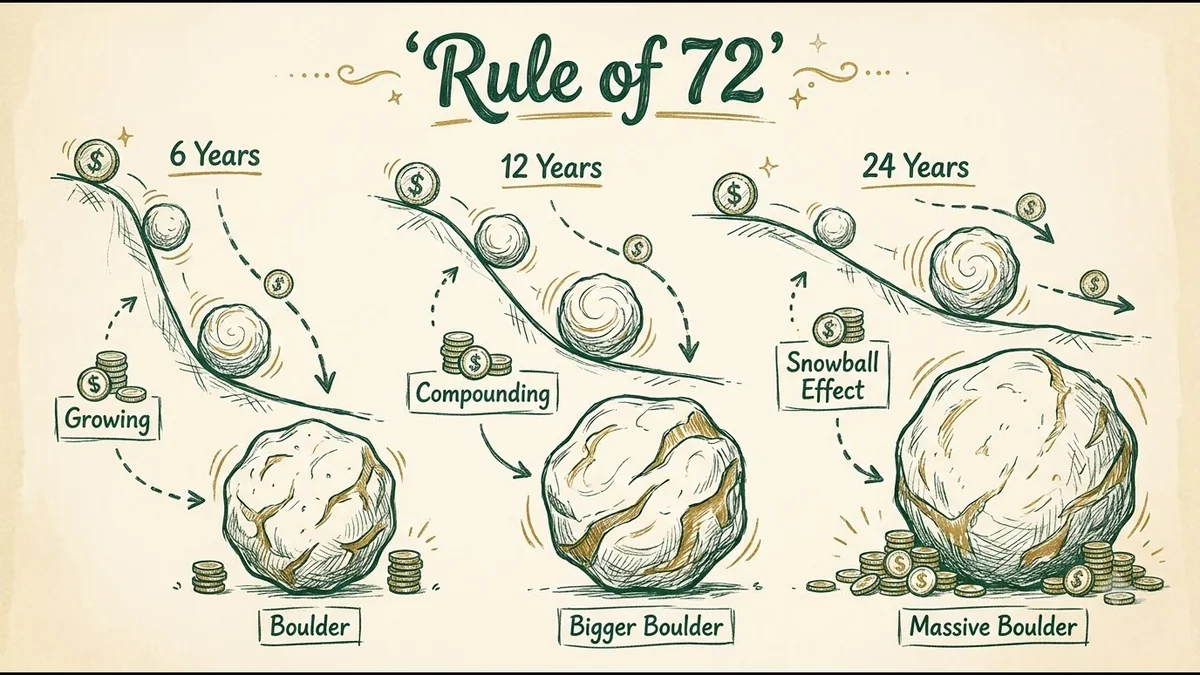
Divide 72 by your annual return to get the years it takes to double your money.
- Initial capital = ₹1,00,000; return = 6%
- Years to double = 72 / 6 = 12 years
So ₹1,00,000 earning 6% a year becomes ₹2,00,000 in about 12 years. Push the return to 9% and the doubling time drops to 8 years — the same money, five years earlier. A quick sanity check with FD and debt-fund rates: at 7%, expect a doubling in just over 10 years.
The rule also works in reverse: divide 72 by the years to find the return you need. Want to double in 8 years? 72 / 8 = 9% a year. (Our compound interest calculator on this site does the exact math when you want precision.)
Rule of 114 — time to triple
Same trick, different constant: divide 114 by the annual return to get the time to triple.
- Initial capital = ₹1,00,000; return = 6%
- Years to triple = 114 / 6 = 19 years
Notice the pattern: doubling at 6% took 12 years, tripling takes 19 — only seven more years for a 50% bigger outcome. That asymmetry is compounding at work. The later years do disproportionate work, which is exactly why investors who cash out at year 12 capture the least valuable part of the curve.
Rule of 144 — time to quadruple
Divide 144 by the return for the time to quadruple your money.
- Initial capital = ₹1,00,000; return = 6%
- Years to quadruple = 144 / 6 = 24 years
From 19 to 24 years, the money doubles again. Run the same numbers at 12% — plausible for long-run equity returns — and the picture changes: double in 6 years, triple in 9.5, quadruple in 12. The difference between a 6% and a 12% instrument is not twice the outcome; it is four times the outcome over 24 years. Cost and asset allocation decide that gap, which is why fees deserve more attention than stock tips.
Rule of 70 — inflation's tax on idle money
The fourth rule works against you. Divide 70 by the inflation rate to find how long your money takes to lose half its purchasing power.
- Idle cash = ₹1,00,000; inflation = 7%
- Years to half = 70 / 7 = 10 years
Money parked in a 3%-interest savings account while inflation runs 6-7% loses roughly half its real value in about 10-14 years. India's long-run CPI inflation has averaged around 5-6% (Source: RBI and MoSPI CPI series), so the practical bar is clear: any long-term instrument should clear roughly 6% just to stay level in real terms.
The four rules in one table
4 of 4 rows
| Rule | Divide by | Tells you | Example at 6% |
|---|---|---|---|
| Rule of 72 | 72 | Years to double | 12 years |
| Rule of 114 | 114 | Years to triple | 19 years |
| Rule of 144 | 144 | Years to quadruple | 24 years |
| Rule of 70 | 70 | Years for inflation to halve value | 10 years (at 7%) |
Where these rules meet your actual investments
- FD at 7%: doubles in ~10.3 years, barely beats 6% inflation. Real growth: thin.
- PPF at 7.1%: doubles in ~10 years. The rate has held at 7.1% through 2026 — unchanged again for the October-December quarter (Source: Ministry of Finance small-savings rate circulars, as reported by Economic Times and Business Standard, October 2026).
- Nifty index fund, long-run ~12%: doubles in 6 years. Not guaranteed in any decade — the 2010s and 2020s have alternated feast and flat — but the rule shows what the engine can do.
- Monthly SIP at 12%: ₹10,000 a month reaches roughly ₹1 crore in about 20 years, and the last 5 years contribute more than the first 10 — the same curve, seen from the contribution side.
The mistakes that break compounding
- Withdrawing early. Every withdrawal resets the interest-on-interest clock at its steepest point. Treat long-term money as untouchable, not as a parking lot.
- Chasing last year's winner. Switching funds every year restarts your personal compounding and adds exit loads and tax. Consistency beats optimisation.
- Interrupting SIPs in a crash. The cheapest units you will ever buy arrive exactly when the news is worst. A SIP paused in a drawdown deletes the rule of 144's favourite years.
- Leaving money idle "for safety." The rule of 70 is the price of that comfort — measurable, and larger than most people guess.
How accurate is the rule of 72?
5 of 5 rows
| Return | Rule of 72 says | Exact maths says |
|---|---|---|
| 6% | 12 years | 11.9 years |
| 9% | 8 years | 8.0 years |
| 12% | 6 years | 6.1 years |
| 18% | 4 years | 4.2 years |
| 24% | 3 years | 3.2 years |
It is an approximation, and nearly exact across the range most savers care about. The exact doubling time is ln(2) divided by ln(1 + r):
Within about half a year everywhere. The rule slightly flatters high rates, which is the safe direction to be wrong in when you are estimating what an investment must earn to hit a deadline.
The ladder at 7%, 9% and 12%
| Return | Double (72/r) | Triple (114/r) | Quadruple (144/r) |
|---|---|---|---|
| 7% | 10.3 | 16.3 | 20.6 |
| 9% | 8.0 | 12.7 | 16.0 |
| 12% | 6.0 | 9.5 | 12.0 |
The four rules stack into one planning table (years, read straight off the rules):
At 12%, money quadruples inside 12 years — faster than a single PPF cycle. At 7%, quadrupling takes 20.6 years. That is why the gap between a 7% product and a 12% one is not a detail of returns; it is whether you live to see two doublings or three in the same working life.
The cost of waiting, priced
Illustration: ₹10,000 a month into equity at an assumed 12% a year (compounded monthly), from three starting ages:
- Start at 25: about ₹5.2 crore by 60, on ₹42 lakh invested.
- Start at 30: about ₹2.9 crore, on ₹36 lakh invested.
- Start at 35: about ₹1.6 crore, on ₹30 lakh invested.
Each five-year delay costs more than every rupee you contributed in the whole plan. Compounding's steep years are the last ones; arrive late and you simply miss them.
What a 1% fee does to the curve
Fees lower the return the rules are fed. Illustration: a ₹10,000 monthly SIP for 30 years at 12% builds about ₹3.5 crore; at 11% — the same fund carrying a one-point higher expense ratio — about ₹2.4 crore. Around ₹1.1 crore of the corpus goes to costs. On the doubling clock, a one-point lower return stretches every doubling from 6 years to about 6.5, and those half-years compound across a portfolio's life. It is why the direct-plan decision (see our index funds guide) matters more than fund-picking skill.
Compounding in reverse: expensive debt
The same rules price the money you owe. Illustration: a hypothetical balance costing 2% a month doubles what you owe in about 3 years (72 divided by 24) — the rule of 72 does not care whose money is compounding. This is the mirror image of the rule of 70: inflation compounds against idle cash, card interest compounds against revolving balances. Clearing such a balance is a guaranteed, tax-free return equal to its rate.
Putting the rules to work this week
1. Write down the blended return your current portfolio actually earns, after fees.
2. Check it clears the ~6% real-value bar from the rule of 70.
3. Compute the doubling time on your most expensive loan, then decide whether prepaying beats investing.
4. Feed your own numbers into the compound interest calculator.
5. Automate one increase — a step-up SIP or a recurring deposit hike — so next year's doubling starts from a bigger base.
Conclusion
The four rules reduce portfolio design to one line: your rate of return should comfortably clear inflation, and your holding period should be measured in decades, not quarters. At 6% you quadruple in 24 years; at 12% you quadruple in 12. The rules do not invest for you — but they make the cost of waiting, and the value of staying, impossible to ignore.
Frequently asked questions
What is the rule of 72 in simple terms?
Divide 72 by your annual rate of return to estimate how many years your money takes to double. At 8% it doubles in about 9 years; at 12% in about 6. It is an approximation, accurate within a few months for typical returns.
How long does it take to double money at 7%?
About 10.3 years (72 divided by 7). At 9% it takes 8 years, and at 12% only 6 — which is why even small differences in long-term returns change outcomes dramatically.
What is the rule of 70 for inflation?
Divide 70 by the inflation rate to see how many years it takes for money's purchasing power to halve. At 7% inflation, cash loses half its real value in 10 years — the reason long-term savings must out-earn inflation.
Is the Einstein compound interest quote real?
It is widely attributed to Einstein but there is no reliable source for him saying it. The math it describes is real regardless — compounding genuinely accelerates, and the rules of 72, 114, 144 and 70 are the quick way to see it.
About the author
Om Patel is an investor, blogger and entrepreneur. Every guide is educational, not personalised advice; rates and rules are cited to official sources and reviewed with a visible date.
Educational content, not personalised advice. Rates change — verify on the bank's site before opening an account. How we make money